
5
Readiness dimensions
20+
Practical criteria reviewed
1
Prioritised blueprint
90-day
Recommended pilot roadmap
The Challenge
Customer intelligence is still trapped behind screens.
Employees and customers often move between CRM, ERP, service, data, portals, email and collaboration tools to complete a single task.
A connected experience brings trusted context, intelligence and governed actions into the flow of work while preserving the permissions, controls and auditability required by the enterprise.
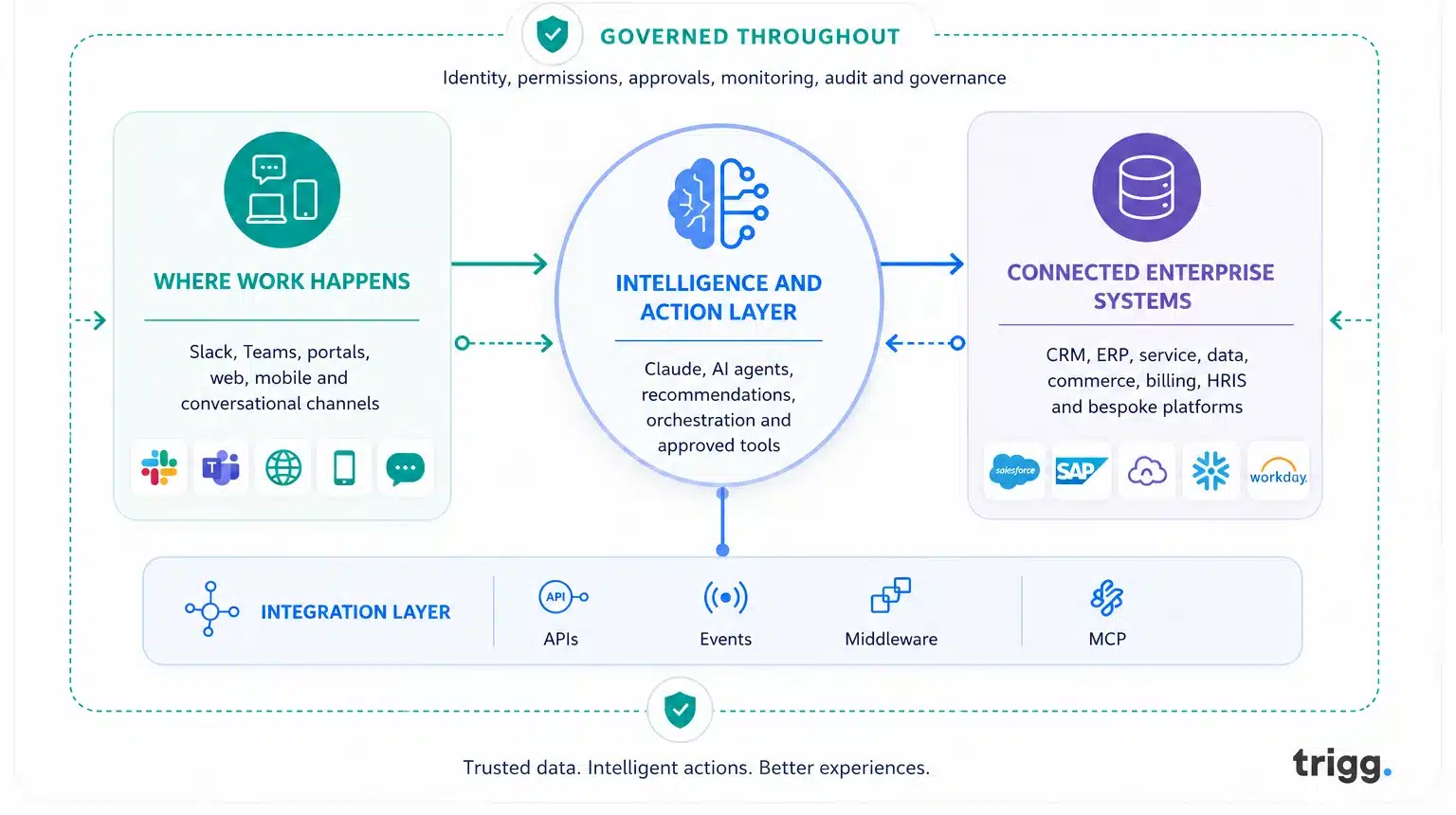
Assessment Framework
Assess the foundations required for connected, AI-powered experiences.
The assessment reviews the journey, data, architecture, controls and operating capabilities needed to move safely beyond a traditional system interface.
Experience & Workflow
Identify high-friction journeys and determine where intelligence and actions should appear.
- User and customer journeys
- System switching
- Manual effort and hand-offs
Customer Context & Data
Validate whether trusted, timely and relevant context is available at the moment of need.
- Data quality and completeness
- Customer identity and context
- Knowledge and insight access
Connectivity & MCP
Review how agents and experiences can securely access data, tools and cross-system actions.
- APIs, events and middleware
- MCP tools and services
- Reliability and observability
Identity & Governance
Define who can see, decide and act, together with the controls required for safe operation.
- Identity and permissions
- Approvals and human oversight
- Audit, risk and compliance
Agent & Operating Model
Prioritise use cases and establish ownership, evaluation, adoption and optimisation.
- Use-case value and feasibility
- Ownership and support
- Evaluation and optimisation
Connected Experience Opportunities
Move intelligence and action closer to the moment of need.
The strongest starting points are usually high-frequency journeys where people need trusted context, recommendations and actions from several systems.
Revenue
Seller workspace
Prepare account briefs, retrieve customer context, update CRM and coordinate next actions from Slack, Teams or another familiar workspace.
Service
Assisted resolution
Bring case history, orders, entitlements, knowledge and recommended actions into the service channel without forcing additional navigation.
Customer
Intelligent self-service
Allow customers or partners to access trusted answers and complete governed actions through portals, websites and conversational channels.
Operations
Cross-system workflow
Coordinate approvals, exceptions and operational tasks across CRM, ERP, billing, fulfilment and collaboration platforms.
Leadership
Conversational insight
Ask questions across trusted business data, receive explained insights and initiate follow-up actions from one governed experience.
Technology
Connected agent layer
Expose approved systems and capabilities through reusable tools or MCP services while preserving enterprise controls and observability.
Tangible Output
Your connected experience blueprint.
An executive-ready blueprint that shows what should change, what must connect, how the experience should be governed and what to prove first.
Readiness Benchmark
The current journey, user pain points, hand-offs, system switching, baseline measures and readiness gaps.
Priority Journey Map
The future interaction, customer context, recommendations, agent actions and human decision points.
Connectivity Blueprint
Systems, data, APIs, events, MCP tools, identity, permissions, approvals, monitoring and audit requirements.
Recommended Pilot Roadmap
The value hypothesis, success measures, proof-of-value scope, delivery phases, dependencies and recommended next decision.
How It Works
Move from opportunity to a working experience.
01
Assess
Review the journeys, customer context, systems, controls and operating capabilities required for connected experiences.
02
Prioritise
Select a focused workflow with clear users, measurable outcomes and manageable integration and governance requirements.
03
Activate
Define the target experience and recommended pilot roadmap, with the option to progress into design and delivery.
Frequently Asked Questions
Common connected experience questions.
What is a connected experience?
A connected experience brings trusted context, intelligence and governed actions into the channels where employees, customers and partners already work, rather than requiring every journey to take place inside a traditional system interface.
How is this different from the Data & AI Readiness Assessment?
Our Data & AI Readiness Assessment reviews the broader organisational foundations required to operationalise AI. The Connected Experience Assessment focuses more specifically on journeys, cross-system actions, integration and MCP, identity, permissions and the operating model required to deliver connected experiences safely.
Where does Salesforce Headless 360 fit?
For Salesforce organisations, Headless 360 is one application of the wider connected experience approach. The assessment can identify where Salesforce data, intelligence and governed actions should be made available beyond the traditional Salesforce interface, while also considering Claude, Agentforce, Data 360 and wider enterprise systems.
What role does MCP play?
MCP can provide a consistent way for AI applications and agents to discover and use approved tools or data sources. It is one possible part of the connectivity architecture alongside APIs, events, middleware and platform-native integrations. Learn more about the Model Context Protocol.
Is the assessment limited to Salesforce?
No. The framework can be applied across Salesforce and wider enterprise estates including CRM, ERP, HRIS, service, data, collaboration, commerce and bespoke platforms.
What does the assessment cover?
It reviews experience and workflow friction, customer context and data, connectivity and MCP opportunities, identity and governance, and agent and operating readiness.
What will we receive?
You will receive a readiness benchmark, priority journey map, connectivity blueprint and a recommended roadmap for a focused connected experience pilot.
Can we quantify the potential value?
Yes. Once a priority journey has been identified, our AI ROI Calculator can help estimate the potential productivity and commercial opportunity before detailed delivery planning.