
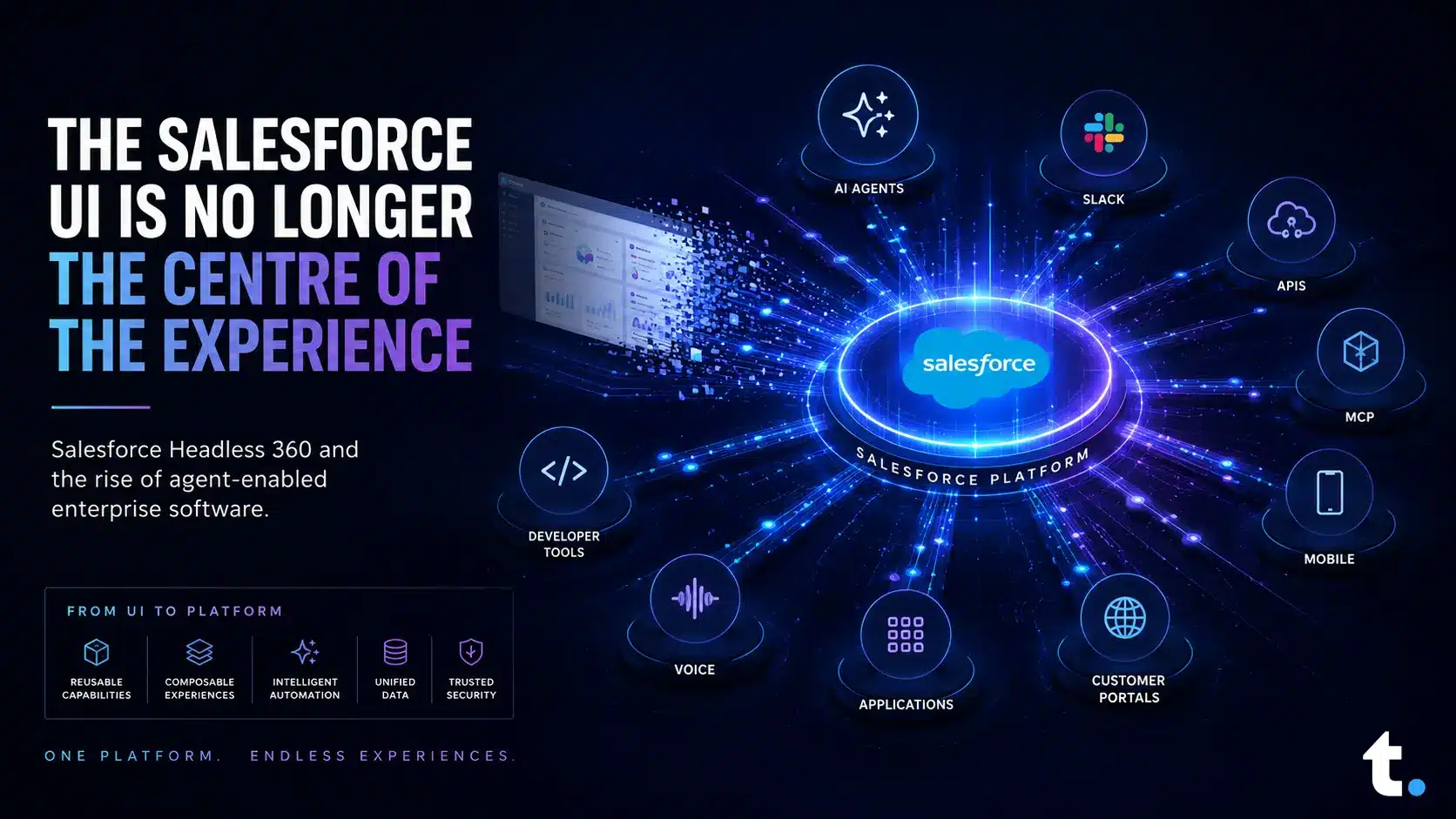
For more than two decades, Salesforce has largely been experienced through a user interface.
Sales teams managed opportunities. Service teams worked through cases. Marketers built campaigns. Administrators configured workflows. Developers deployed change.
Most of that work happened through a browser.
That assumption is now changing.
With Salesforce Headless 360, the platform is becoming increasingly available through APIs, MCP tools, CLI commands and agent-enabled experiences that do not depend on the traditional Salesforce user interface.
At first glance, this sounds like a technical announcement.
In reality, it may be one of the most significant shifts in how organisations interact with enterprise software.
It changes how organisations should think about Salesforce, AI, agents, integration and the future of enterprise software.
“The most important shift is not that Salesforce can be accessed without a browser. It is that business capabilities can now be exposed directly to agents, developers and digital experiences wherever work happens.”
The ShiftSalesforce is evolving from a user interface into a platform of business capabilities that can be consumed directly by AI agents, applications, APIs and MCP-enabled experiences.
The Interface Is No Longer The Centre
Historically, enterprise software has been designed around human interaction.
Users log in. Navigate menus. Search for information. Update records. Trigger workflows. Move between systems.
That model still matters.
But it is no longer the only model.
Headless 360 points towards a future where Salesforce capabilities can be accessed by AI agents, external applications, developer tools, Slack experiences, customer portals, mobile apps and other digital surfaces.
The Salesforce platform remains the system of record, workflow engine and trust layer.
But the experience no longer has to live only inside Salesforce.
Why This Matters For Companies
Traditional Model
- Human user
- Salesforce interface
- Manual interaction
- Business process completed
Headless 360 Model
- Human, agent or application
- Salesforce capabilities
- API or MCP access
- Business outcome delivered
Many organisations are still approaching AI as a productivity tool.
Generate content. Summarise meetings. Answer questions. Draft emails. Accelerate development.
Those use cases are valuable.
But they are only the beginning.
The bigger opportunity comes when AI agents can interact with enterprise data, business processes, permissions, workflows and operational systems in a governed way.
That is where Headless 360 becomes strategically important.
It creates a route for agents and applications to act on Salesforce capabilities directly, rather than simply providing information about them.
For organisations, this could change how work happens across the enterprise.
The impact extends far beyond technology teams. Agent-enabled access has the potential to reshape how work is executed across sales, service, marketing, revenue, data, development and operations.
Sales
Agent-enabled selling, forecasting and commercial execution.
Service
Intelligent issue resolution and workflow orchestration.
Marketing
Connected activation and audience engagement.
Revenue
Commercial processes executed through connected business capabilities.
Data
Trusted context available wherever work happens.
Employee Support
Faster access to knowledge, systems and processes.
Development
API and CLI-enabled delivery across the platform.
Operations
Connected execution across enterprise systems.
The opportunity is not simply that AI becomes more intelligent.
The opportunity is that AI becomes more connected to the systems, processes and context that make work happen.
What We Have Learned Deploying MCP At Trigg Digital
At Trigg Digital, we have deployed our own MCP internally and have been exploring how agent-enabled access to tools, knowledge and systems changes the way teams work.
Our early assumption was that the primary value would be speed.
Faster answers. Faster development. Faster access to information.
That has been true.
But the more important learning has been that MCP reduces friction between knowledge and action.
Instead of switching between systems, searching through documentation or relying on individual knowledge, teams can start to access relevant context and trigger activity from a single interaction.
Some of the early value we have seen includes:
Knowledge Access
Faster access to delivery and project information.
Reduced Search Time
Less time spent navigating systems and documentation.
Asset Reuse
Improved visibility of reusable patterns, assets and prior work.
Technical Efficiency
More efficient investigation, configuration and delivery activity.
But we have also learned something equally important.
MCP is not magic.
The value depends heavily on the quality of the data, the structure of the knowledge, the permissions model and the clarity of the business process.
“Agents are only as useful as the context, governance and systems they can safely access.”
Why Governance Becomes More Important, Not Less
One of the biggest misconceptions about AI is that intelligence solves everything.
It doesn’t.
In enterprise environments, the real challenge is often fragmented context.
Data lives in different systems. Processes vary by team. Permissions are inconsistent. Documentation is incomplete. Business logic sits inside spreadsheets, workflows, integrations and individual knowledge.
When agents begin to interact directly with business systems, these issues become more visible.
As organisations explore AI agents and automation, these foundations become increasingly important.
Trigg InsightOrganisations often think AI success depends on model quality. Our experience suggests it depends far more on the quality of enterprise context, governance and connected business processes.
That means organisations need to focus on the foundations:
- Data quality — Trusted enterprise context.
- Metadata maturity — Structured and reusable platform intelligence.
- Process design — Clear workflows that agents can safely support.
- Security and permissions — Controlled access to systems and data.
- Integration architecture — Connected platforms and workflows.
- Release governance — Safe delivery of change.
- Monitoring and control — Visibility of agent and system activity.
The organisations that have invested in these foundations will move faster.
The organisations that have not will discover that AI exposes operational complexity rather than removing it.
The Bigger Shift
Headless 360 is not just about developers building faster.
It is about making Salesforce capabilities more composable.
Business logic can be reused. Workflows can be surfaced in new places. Agents can operate across systems. Experiences can be built around the way people work, rather than the way software was originally designed.
That has major implications for how companies design technology architecture.
The question is no longer simply:
How do users interact with Salesforce?
The better question is:
How should humans, agents and systems interact with our business capabilities?
That is a very different design challenge.
What Companies Should Do Now
Headless 360 is still an emerging shift, but organisations do not need to wait before preparing.
The practical starting point is to assess whether the business has the foundations required for agent-enabled work.
That means understanding:
01
Process Landscape
Understand where key business processes live.
02
Data Readiness
Assess quality, accessibility and ownership of critical data.
03
Workflow Exposure
Identify which processes could safely be agent-enabled.
04
Governance
Define controls before agents act on behalf of users.
For many organisations, this is where a Data & AI Readiness Assessment becomes valuable.
Before deploying agents at scale, businesses need to understand whether their data, processes, security model and operational controls are ready.
Without that foundation, AI initiatives can quickly become disconnected experiments.
With it, they can become a route to measurable operational value.
Final Thoughts
Every major technology shift is initially viewed through the lens of what came before.
Cloud was seen as outsourced infrastructure.
Mobile was seen as a smaller version of desktop software.
AI was initially seen as a better chatbot.
Headless 360 may follow the same pattern.
It is easy to see APIs, MCP tools and agent connectivity as technical capabilities.
But the bigger story is that enterprise software is becoming increasingly interface-optional.
At Trigg Digital, our early MCP work has shown us that the value is not just in faster execution.
It is in connecting knowledge, systems and action in a more natural way.
For organisations using Salesforce, Agentforce, Data 360, Slack and connected enterprise platforms, this is an important moment.
The companies that prepare now by investing in data, governance, architecture and operational readiness will be best positioned to unlock value as agentic technologies continue to mature.
Because the future of enterprise software is not simply AI-powered.
It is increasingly interface-optional.
The organisations that win will not simply be those deploying AI.
They will be the organisations that make their business capabilities, data and governance agent-ready.
Leadership TakeawayThe future of enterprise software is not just AI-powered. It is increasingly interface-optional, agent-enabled and dependent on trusted data, governance and business-ready architecture.
Ready To Explore What Agent-Enabled Salesforce Could Mean For Your Organisation?
At Trigg Digital, we help organisations assess their data and AI readiness, modernise Salesforce architecture, design agent-enabled workflows and unlock value from connected enterprise platforms.
Whether you are exploring Agentforce, Data 360, MCP, automation or broader Salesforce transformation, the right foundations will determine how quickly and safely you can move from experimentation to business value.
