
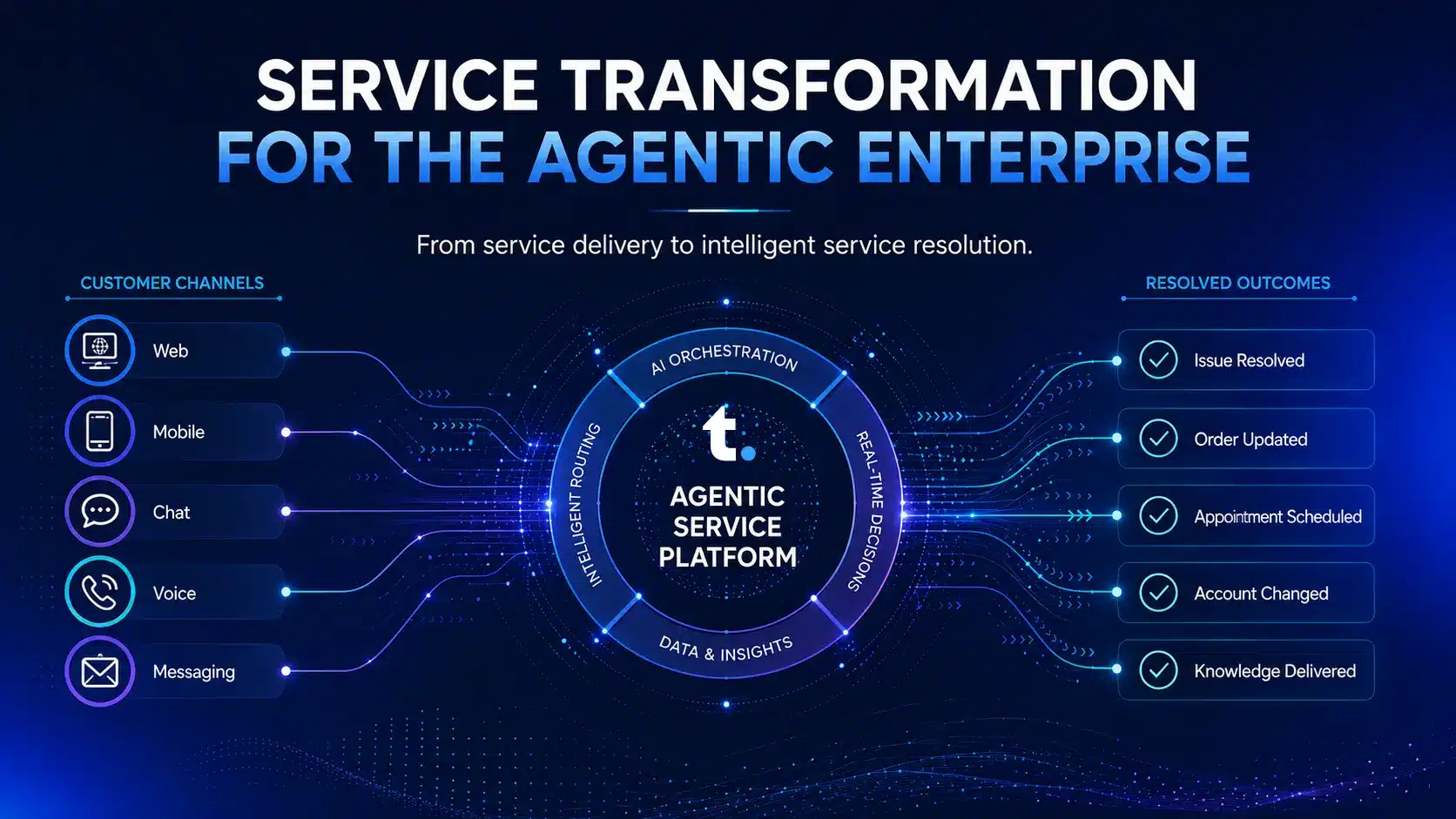
For years, customer service transformation has focused on incremental improvement.
Reduce average handle time. Improve agent productivity. Increase self-service adoption. Deflect more tickets.
While these initiatives have delivered value, they were designed for a world where service operations scaled through people.
More customers meant more agents. More interactions meant larger contact centres. More complexity meant more management overhead.
The result was a fundamentally linear operating model.
Key InsightThe organisations that win the next decade of customer service won’t have the largest contact centres. They’ll have the most intelligent operating models.
Today, that model is reaching its limits.
Customer expectations continue to rise. Service teams are under pressure to reduce costs. Many organisations are now investing in broader customer experience transformation initiatives to improve service quality while reducing operational effort.
Organisations are being asked to deliver better experiences without increasing headcount.
At the same time, AI is changing what is possible.
The question is no longer how to optimise customer service.
The question is how to transform it.
The Service Transformation Challenge
Many organisations have invested heavily in customer service platforms over the past decade.
They have implemented CRM systems, knowledge bases, chat capabilities, automation workflows and customer portals.
Yet despite significant investment, common challenges remain.
Rising Costs
Service demand continues to increase while budgets remain under pressure.
Higher Expectations
Customers expect faster, more personalised and more consistent experiences.
Operational Complexity
Knowledge, data and processes remain fragmented across systems.
AI Disruption
Service leaders are under pressure to adopt AI while managing risk.
Service leaders are finding themselves trapped between two competing priorities: improving customer experience while reducing cost to serve.
Traditionally, organisations were forced to choose one or the other.
AI is changing that equation.
The Shift From Service Delivery to Service Resolution
The next generation of service transformation is not about helping agents work faster.
It is about helping customers get outcomes faster.
This represents a fundamental shift.
Traditional Service
Focused on managing interactions, routing cases and reducing queue pressure.
AI-Powered Service
Focused on understanding intent, executing actions and resolving outcomes.
Instead of routing a customer to an agent, intelligent AI systems can increasingly understand intent, access information, execute actions and resolve issues autonomously. This is where AI agents and automation begin moving beyond productivity assistance and into outcome delivery.
This changes the role of both technology and people.
Technology moves from being a system of record to a system of action.
Human agents move from handling routine transactions to focusing on complex conversations, relationship management and exception handling.
The goal is not to replace people.
The goal is to allow people to focus on work where they create the greatest value.
The Service Transformation Journey
Most organisations are somewhere on this journey today.
01
Assisted Service
AI helps employees work faster through search, summaries and recommendations.
02
Augmented Service
AI resolves simple enquiries while employees focus on more valuable interactions.
03
Autonomous Service
AI agents can understand intent, make decisions and execute actions autonomously across service processes.
What Service Leaders Should Focus On
Successful service transformation is measured by business outcomes, not technology deployments.
- Cost to Serve — Reduce effort and resources required to resolve customer issues.
- Productivity — Free service teams from repetitive and transactional work.
- Customer Satisfaction — Deliver faster and more consistent experiences.
- Scalability — Support growth without matching increases in headcount.
- AI Readiness — Build the foundations for autonomous service.
These questions often reveal that the biggest barriers are not technology limitations.
They are process complexity, fragmented data and years of accumulated operational debt.
Why Existing Salesforce Investments Matter
One of the biggest misconceptions surrounding AI transformation is that organisations need to start again.
In reality, most already possess many of the capabilities required.
Customer Data
The foundation for understanding context, history and intent.
Knowledge Articles
The source of trusted answers, policies and guidance.
Service Workflows
The repeatable processes that AI agents can help execute.
Automation Logic
Existing rules and flows that can become part of an intelligent service model.
Digital Channels
The places where customers already expect fast, consistent support.
Existing Investment
The platform foundations that can be extended rather than replaced.
The opportunity is often not replacing existing investments.
It is unlocking more value from them.
Modern AI platforms can build on existing service foundations and accelerate the journey towards autonomous service without requiring wholesale replacement programmes. Organisations already using Salesforce Service Cloud often possess many of the workflows, knowledge assets and customer data required to begin that journey.
For service leaders, this dramatically reduces risk while accelerating time to value.
What Good Looks Like
Leading organisations are already moving towards a different service operating model.
- Routine enquiries resolved automatically — Customers get answers and outcomes faster.
- Agents focused on higher-value work — Human teams spend more time on complex, sensitive and relationship-led conversations.
- Knowledge available instantly — Trusted answers can be surfaced consistently across every channel.
- Service operations scale efficiently — Growth no longer requires a linear increase in headcount.
- Issues resolved proactively — AI identifies and addresses problems before customers need to contact support.
Leadership TakeawayService transformation is no longer about improving the contact centre. It’s about redesigning the service operating model for the AI era.
The Opportunity Ahead
Most organisations do not need to replace their customer service platform.
They need to unlock more value from it.
By combining AI, automation, trusted data and modern service operating models, organisations can reduce costs, improve experiences and create a foundation for long-term growth.
For organisations evaluating their next steps, our Data & AI Readiness Assessment provides a practical starting point.
The organisations that begin this journey today will be best positioned to compete in an increasingly autonomous future.
