
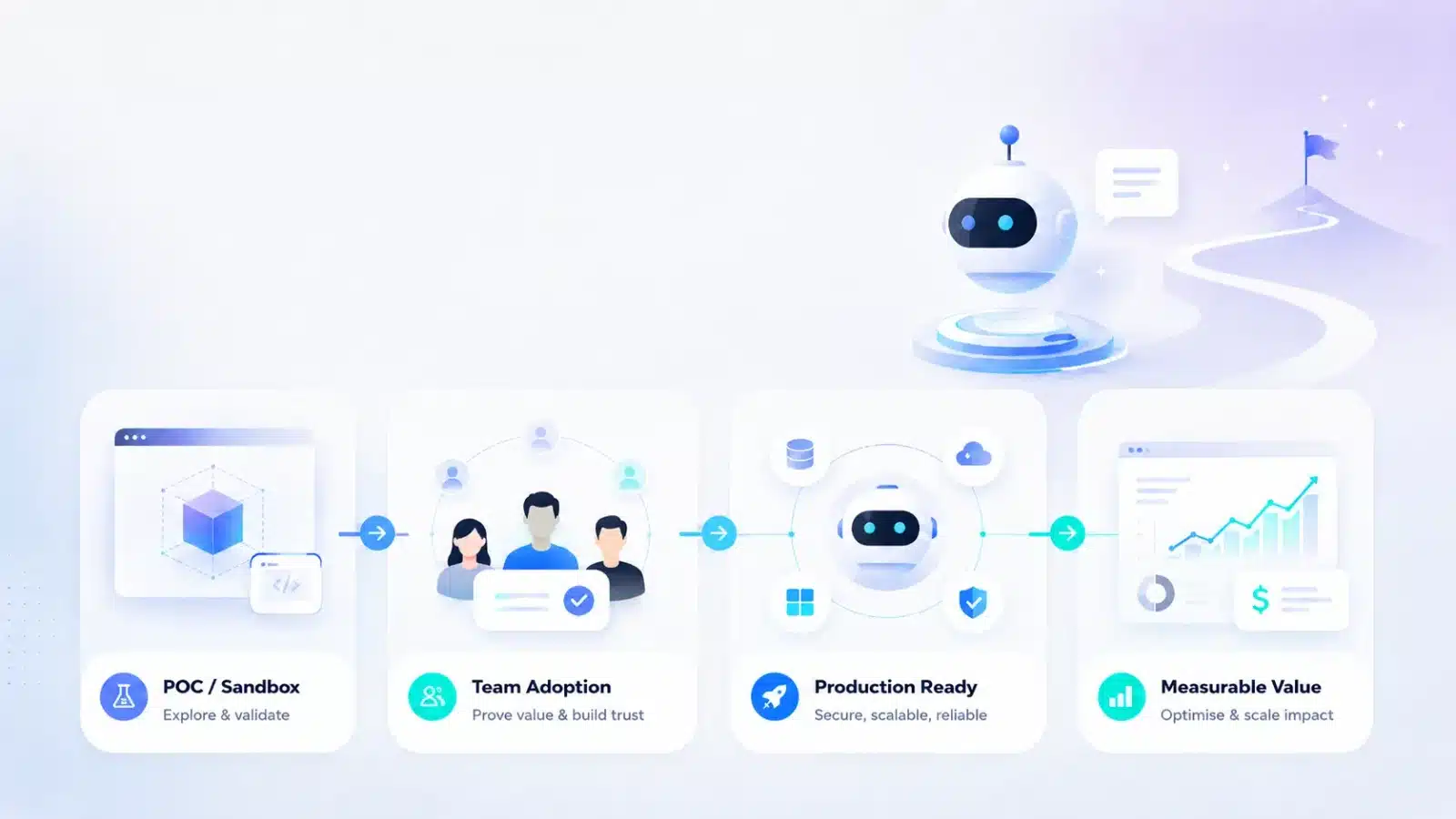
You've built a working agent in Salesforce or Claude. It handles customer inquiries faster than your team could. The demo landed. Finance approved budget for the next phase.
Then you hit the wall.
The agent works in the pilot. But when you try to scale it, adoption is slower than expected. Your team doesn't trust it. The data integration is messier than you thought. Six months in, you're still waiting for the business case to justify continuing. You're not alone. This is where most Agentforce and AI initiatives stall—not because the technology failed, but because moving from proof of concept to measurable value requires a fundamentally different kind of work.
The POC-to-production gap isn't what you think
You proved the agent works. That's valuable. But production is where adoption, governance, training, and handoff happen. That's where the real work starts.
In our experience, the failures aren't technical. It's that teams don't understand why they should trust the agent. Customer data doesn't flow cleanly. No one's measuring whether it's actually saving money. And once you go live, there's no clear owner of the operation.
An agent that works in a sandbox is proof you can build. An agent that works in production and delivers measurable value is proof you can transform business outcomes.
Your team's adoption decides whether it survives
This is the turning point. You can have brilliant technology, but if your team doesn't use it, it fails. Adoption isn't about pushing adoption—it's about making sure the people who'll operate it feel confident and own the outcome.
Ask yourself these questions: Does your support team trust the agent's answers? Do they know when and how to override it? Have they been trained on the new workflow? Is there a clear escalation path when something goes wrong? Does your manager have dashboards showing whether handle time is actually improving?
These rarely get answered during a pilot. But they're the difference between an agent that touches 10% of your workload and one that transforms how you work.
Someone is accountable for the agent's performance in production.
Your team understands the workflow change, not just the interface.
They're trained and know when and how to intervene.
You know whether it's delivering the business outcome you set.
Issues surface quickly and feed into iteration.
Design for handoff before you build
This is where most POCs stumble. Teams build to prove the concept, then hand it to a team that wasn't part of the build. The builders move on. Knowledge walks out the door.
Build for handoff from the start:
Your team can run it without the original builders.
You spot problems before customers do.
You know what success looks like for response time and accuracy.
The agent improves rather than stagnates.
The agent is half the equation. The operation around it—people, process, metrics—is what turns a prototype into value.
What will the business outcome actually be? Revenue? Efficiency? Write it down and measure it.
Does your team have the data, clarity, and capacity to adopt this? What training is needed?
Who owns it in production? What monitoring and escalation do they need?
Prove ROI in the pilot. Use those results to justify the next phase.
Measure from day one
Most teams launch agents, claim victory, and can't prove they delivered value. By then, you've lost the conversation—and the budget.
Start measuring during the pilot. What's your baseline? How much time does the agent actually save per interaction? Are customers satisfied? What's your cost per interaction, and is it lower than before? These numbers become your business case and your proof point for continued investment.
Measurement also drives iteration. If the agent solves 60% of inquiries and escalates 20% unnecessarily, you know exactly what to build next. Without it, you're flying blind.
Conclusion
The technology works. That's the baseline. The difference between a stalled pilot and a transformation is adoption, operationalisation, and proof.
Start thinking about these challenges before you build. Involve the teams who'll operate it. Design for handoff. Measure relentlessly. That's how a sandbox POC becomes a production transformation.
Ready to move beyond the pilot?
We've worked with teams across retail, media, financial services, and more through this exact phase—moving from agent POC to measurable value. Adoption, operationalisation, and proof are where the work really is. If you're navigating this challenge, let's talk about what's worked for others in your space.
