
Every CRO has had the conversation by now: the board wants to see AI in the number, not just in the roadmap. So a pilot goes live somewhere in the funnel — a chatbot on the website, a copilot for the sales team, an agent that drafts follow-up emails — and six months later it's still a pilot. Pipeline hasn't moved. Cash conversion hasn't moved. The instinct is to blame the tool. Usually the real problem is scope: AI has been pointed at one moment in the customer journey, not at the chain that actually produces revenue.
That chain is lead-to-cash — the sequence from first engagement through qualification, quoting, contracting, ordering and collection. It's also, not coincidentally, the sequence most B2B revenue leaders already track in a weekly forecast call. Treat AI as a lifecycle investment rather than a point solution, and be deliberate about which stages get autonomy versus assistance, and the return case gets a lot clearer.
Why point solutions stall
Most first AI projects land on the noisiest stage — usually top-of-funnel outreach or front-line service — because that's where the volume and the vendor demos are. The trouble is that a faster lead score or a drafted email doesn't change anything downstream if quoting still takes a week and contract review still queues behind legal. The lifecycle is only as fast as its slowest handoff, and a single accelerated stage just moves the bottleneck along rather than removing it.
This is also why a lot of early agentic pilots stall at proof-of-concept: they were scoped as a feature, not as a stage in a revenue process with a defined handoff in and a defined handoff out.
Assisted and autonomous are two different investments
It helps to stop treating "AI in the funnel" as one decision and start treating it as a set of decisions, one per stage, each answering a simple question: does a person decide, with AI preparing the ground, or does AI act within limits a person has already set?
Assisted AI drafts, ranks, summarises and recommends; a person still makes the call. Autonomous AI executes within guardrails — issuing a standard quote, chasing an overdue invoice, updating a CRM record — and a person only intervenes on exceptions. Both are legitimate uses of the same technology. The mistake is assuming the whole lifecycle should be one or the other.
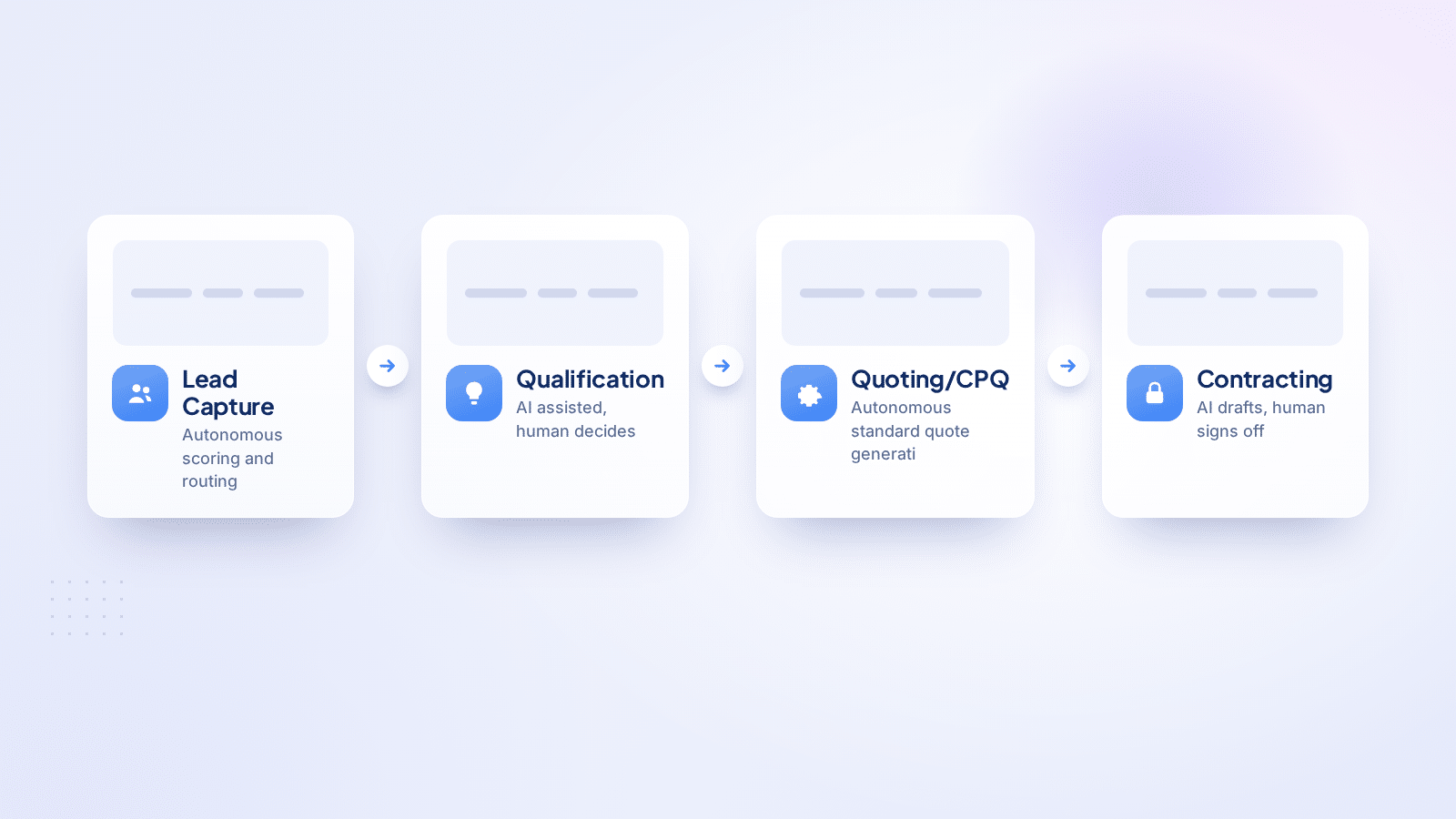
AI ranks and routes leads against agreed criteria, autonomously, freeing reps for conversations that matter.
AI surfaces intent and account signals for the rep to assess; the decision to progress stays human.
Standard, in-policy quotes generate autonomously; anything non-standard routes to a rep.
AI drafts and checks terms against policy; a person still signs off on exceptions and pricing.
AI reconciles orders and chases routine collections autonomously, with finance managing exceptions.
Where the human line has to stay
Autonomy is attractive because it removes admin, not because it removes judgement. The stages worth watching closely are the ones where a wrong autonomous decision costs money or trust: discounting outside policy, contract terms that create liability, or collections activity against a strategic account. None of that is an argument against automation — it's an argument for putting the approval point in the right place before switching autonomy on.
There's a documented rule set an agent can be trained and audited against, not tribal knowledge.
Anything outside policy has an obvious, fast route to a human.
The record an agent acts on is trustworthy enough to act on without a person checking first.
Every autonomous action is logged and explainable after the fact.
Start with one handoff, not the whole funnel
The practical route in is to pick a single, well-understood handoff — one with volume, clean data and a clear policy — prove assisted or autonomous AI works there, and only then extend it along the chain. That's a smaller, faster business case than "transform the funnel", and it's also how the return shows up somewhere a CRO or CFO can point to it: cycle time on one stage, not a vague productivity story.
The lead-to-cash chain moves at the speed of its slowest handoff — autonomy in one stage is wasted if the next one is still manual.
None of this requires picking a side between "AI will run sales" and "AI is a toy". It requires being specific: which stage, which decision, assisted or autonomous, and who owns the exception. That specificity is what turns a pilot into a number the board actually believes.
Where does your lead-to-cash chain lose the most time?
We work with revenue and commercial teams to map the lifecycle stage by stage, agree where assisted or autonomous AI genuinely applies, and prioritise the handoff worth fixing first.
