
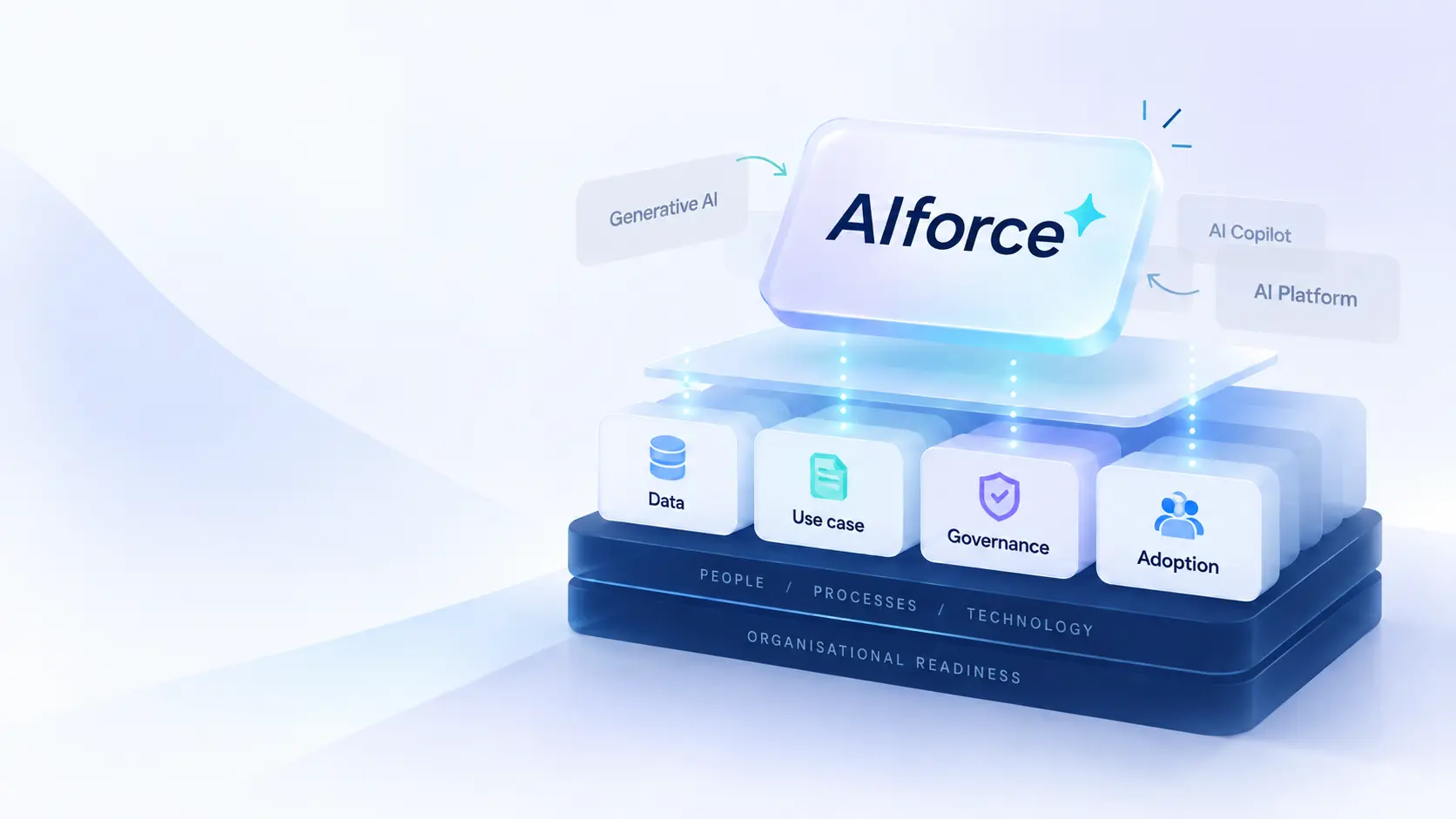
Dreamforce 2026 brought another significant evolution in Salesforce's AI strategy. AIforce extends the platform beyond the traditional Salesforce interface, opening up new ways for AI experiences to work with the data, workflows and business logic already sitting inside the Salesforce ecosystem.
That's important. But for CIOs, RevOps leaders and transformation directors deciding what to do next, the bigger question hasn't changed: what turns increasingly capable AI technology into measurable business value?
New interfaces and more capable agents expand what's possible. They don't remove the work required to make AI useful, trusted and adopted inside a real organisation.
The technology moves fast. The fundamentals don't.
AIforce represents a meaningful step in Salesforce's AI direction. It points towards a world where Salesforce isn't simply the application employees log into, but a trusted source of customer context, workflows and actions that can increasingly be surfaced through the AI environments where people already work.
That creates interesting possibilities. But the constraints that determine whether AI delivers value inside an organisation remain remarkably consistent. Data still has to be clean, connected and trusted. A use case still has to be worth solving before it's worth automating. Governance still matters. And people still have to change how they work, rather than simply having another tool added to an existing process.
Our approach to AI is deliberately model-agnostic. We work across Salesforce and Claude, and increasingly across architectures where multiple models, platforms and interfaces need to work together. The technology matters, but the badge on the licence is rarely the only thing standing between a business and value from AI.
We've seen well-funded AI pilots — from platform-native agents to bespoke model deployments — struggle for remarkably similar reasons: not because the underlying technology wasn't capable, but because the organisation hadn't defined what good looked like, what data could be trusted, or who remained accountable for the outcome.
What actually decides whether AI pays off
Strip away the keynote and the same readiness factors show up across almost every successful AI programme we've worked on, regardless of which model or platform sits underneath it.
If the underlying data is inconsistent or siloed, AI inherits those problems — only faster.
Not AI for the sake of it — a specific business problem worth solving, with a clear way to measure whether it worked.
Clear points where a person approves, corrects, intervenes or can stop an agent from acting.
The people who'll use it are involved before go-live, rather than being introduced to it afterwards.
Design for a world where Salesforce, Claude and other models or interfaces may need to work together.
None of that is particularly exciting on a keynote stage. All of it determines whether a pilot becomes something the business actually relies on, or a slide that quietly disappears from next year's roadmap.
Where the effort should actually go
For leaders under board pressure to "do something with AI", the temptation after an announcement like this is to chase the newest capability. The more useful move is to invest just as deliberately in the foundations that make any AI investment more likely to deliver.
Data foundations
Get the data an agent will actually touch into a state you'd trust a person to use.
Use case selection
Pick the problem with a credible route to measurable value, not simply the most impressive demo.
Change & adoption
Treat AI as a business change programme enabled by technology, not simply a technology implementation.
Governance
Decide upfront where AI can act autonomously and where human review or approval is required.
The organisations getting the most value from AI aren't necessarily the ones with the newest licence — they're the ones that have done the readiness work required to turn capability into measurable outcomes.
That's not a dismissal of AIforce or Salesforce's direction of travel. Quite the opposite. A more open and coherent AI layer around Salesforce creates meaningful opportunities for organisations that are ready to use it.
It also reflects a broader shift in enterprise technology. The future is unlikely to be one model, one agent or one interface owning every interaction. Salesforce may hold the customer context and workflows. Claude may be where someone reasons through a complex problem. Other models and interfaces may play different roles again.
The organisations best placed to take advantage of that future will be those that think about AI as an architecture and operating model, rather than a single product deployment.
The conversation worth having
Every Dreamforce creates a useful moment: new capability, fresh internal interest and often a window for leaders to secure investment in AI.
The organisations that make the most of that window won't necessarily be the ones that adopt every new capability first. They'll be the ones that understand where AI can create measurable value, build the foundations to support it, and choose the right combination of platforms, models and people to deliver it.
If you're weighing up what AIforce — or any AI investment — actually means for your organisation, the conversation worth having first isn't simply "what can the technology do?" It's "where can this genuinely change an outcome for our business, and are we ready to make that happen?"
Weighing up what AIforce means for your organisation?
Talk to us about where your data, use cases, architecture and teams actually stand today — and how Salesforce and Claude can work together to turn AI capability into measurable business value.
