
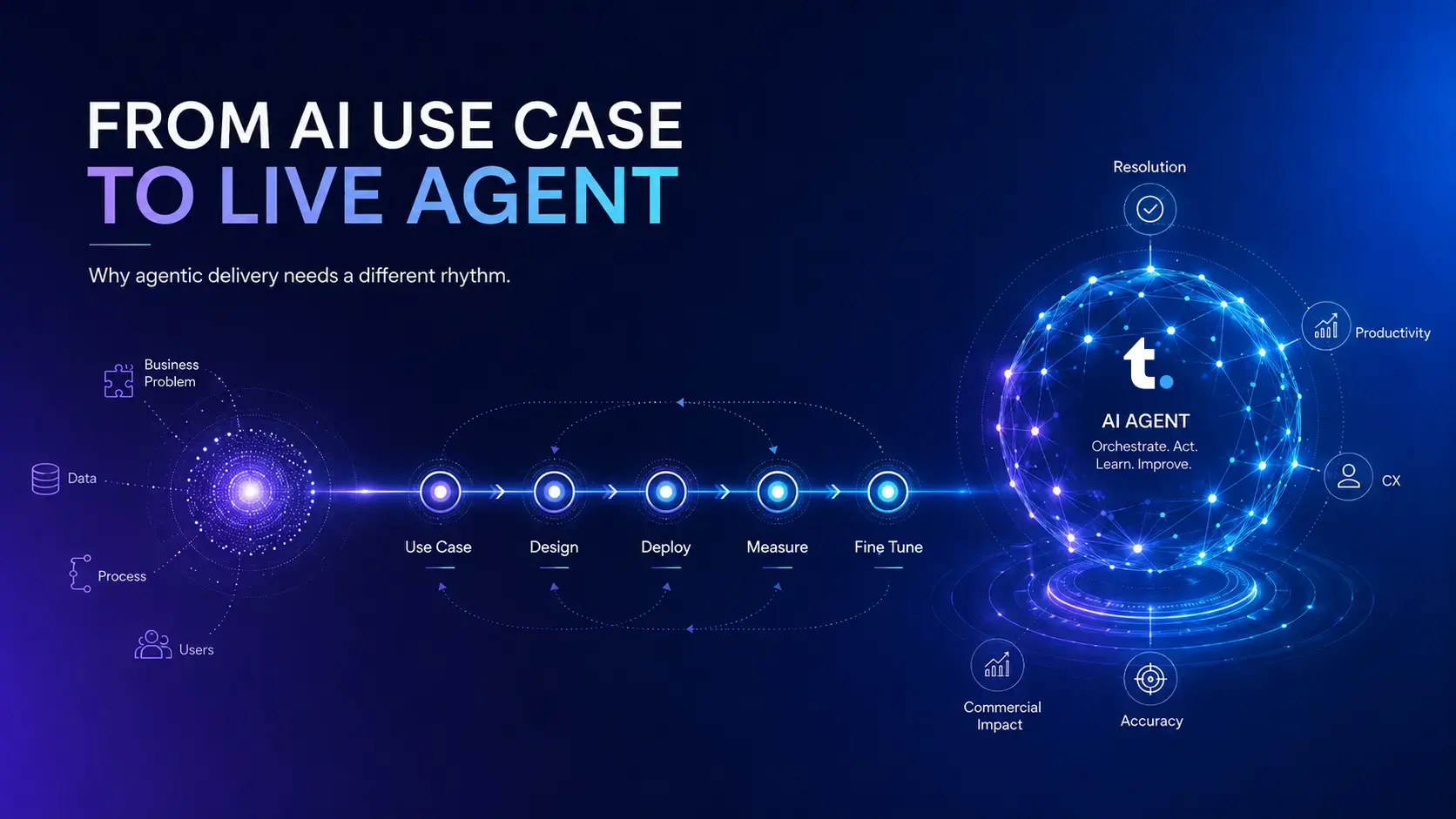
AI and agentic projects are changing how organisations need to think about delivery.
For years, technology projects have followed a familiar pattern.
Define the scope. Gather the requirements. Build the solution. Test it. Launch it. Move on.
That model still has a place.
But AI agents are different.
An AI agent is not a static workflow or a one-off automation. It is a capability that needs to understand context, make decisions, take action and improve over time.
That changes the delivery rhythm.
The question is no longer simply whether an AI agent can be built.
The question is whether it can deliver measurable business outcomes in the real world.
Key InsightAgentic AI projects do not succeed through one-off deployments. They succeed through focused use cases, measurable outcomes, iterative releases and continuous fine-tuning.
As organisations move from AI experimentation into live delivery, the most successful teams are changing their approach.
They are starting smaller. Measuring faster. Learning earlier. Improving continuously.
That shift is critical.
Because the value of AI is not unlocked at the point of launch.
It is unlocked through the operating rhythm that follows.
The Shift in AI Delivery
Traditional technology projects are often judged by whether they are delivered on time, on budget and against an agreed scope.
Those measures still matter.
But they are not enough for AI.
With AI and agentic delivery, success depends on how well the solution performs once it is live.
Can it resolve the right enquiries?
Can it reduce manual effort?
Can it improve customer or employee experience?
Can it be trusted to take the right action?
Can it improve over time?
This creates a different delivery mindset.
Traditional Delivery
Focused on requirements, scope, build, testing and deployment.
Agentic Delivery
Focused on use cases, outcomes, controlled releases, measurement and continuous improvement.
In traditional delivery, launch is often seen as the end of the project.
In agentic delivery, launch is the beginning of the learning cycle.
That does not mean governance becomes less important.
It means governance needs to evolve.
AI projects still need clear design principles, security, testing, data controls, stakeholder alignment and change management.
But they also need an ongoing feedback loop that connects performance data, user behaviour, business outcomes and improvement actions.
“The biggest shift in AI delivery is that value is not created by simply going live. Value is created by learning from live usage and improving the agent with purpose.”
Start With the Use Case, Not the Technology
One of the most common mistakes organisations make with AI is starting with the platform.
They ask what the technology can do before agreeing what business outcome they want to improve.
That can lead to impressive demos but limited operational value.
Successful AI delivery starts with a focused use case.
A good use case is not simply a task that could be automated.
It is a business problem where AI can create a measurable improvement.
Clear Business Pain
The process is slow, costly, inconsistent, repetitive or difficult to scale.
Defined Users
The people, teams or customers affected by the problem are clearly understood.
Measurable Outcome
The impact can be tracked through operational, commercial or experience metrics.
Accessible Data
The agent can access the knowledge, records and context required to respond effectively.
Actionable Process
The agent can recommend, trigger or complete a meaningful next step.
Controlled Risk
The use case can be deployed safely with the right guardrails and escalation paths.
This is why the discovery stage matters.
Before building an AI agent, organisations need to understand the current process, the user journey, the data landscape, the decision points, the risks and the desired outcome.
A narrow use case with a clear metric is usually more valuable than a broad AI ambition with no measurable target.
For organisations still assessing where to start, a structured Data & AI Readiness Assessment can help identify the right opportunities, dependencies and delivery priorities.
From Initial Use Case to Iterative Deployment
Agentic delivery works best when organisations move through a controlled and iterative journey.
The aim is not to spend months designing the perfect agent in isolation.
The aim is to get to a safe, valuable first deployment and then improve it through evidence.
01
Identify the Use Case
Define the business problem, user need, success measures, process scope and data requirements.
02
Design the Agent
Map the agent role, instructions, knowledge sources, actions, hand-offs, controls and escalation points.
03
Deploy Iteratively
Release in a controlled way, measure performance, capture feedback and fine-tune the agent over time.
This approach reduces risk.
It allows teams to validate assumptions quickly. It helps stakeholders see value earlier. It creates a practical route from experimentation to adoption.
Most importantly, it recognises that an AI agent will improve through use.
The first release should be valuable, safe and focused.
It does not need to solve every problem on day one.
Why Metrics Matter
AI projects can create excitement quickly.
But excitement is not a business case.
If organisations want to scale AI beyond pilots, they need to prove impact.
That means defining success measures before deployment and tracking them after release.
The right metrics will depend on the use case, but they should usually connect to business value, user adoption and agent performance.
- Resolution Rate — How often the agent successfully resolves the request without unnecessary human intervention.
- Containment Rate — How many interactions are completed within the agent experience while maintaining quality and trust.
- Escalation Quality — Whether hand-offs include the right context, summary and recommended next action.
- Time Saved — The reduction in manual effort for employees, operations teams or service agents.
- Customer Experience — The impact on satisfaction, response time, consistency and ease of resolution.
- Accuracy and Trust — How reliably the agent uses approved knowledge, follows instructions and stays within guardrails.
- Commercial Impact — The effect on cost to serve, conversion, retention, productivity or revenue growth.
Metrics also help teams make better decisions.
They show where the agent is working well. They reveal where users are dropping out. They identify knowledge gaps, confusing journeys and process exceptions.
Without metrics, AI improvement becomes opinion-led.
With metrics, it becomes evidence-led.
Delivery TakeawayThe best AI delivery teams do not just ask whether the agent works. They ask what the agent is improving, how that improvement is measured and what needs to change next.
Fine-Tuning Is a Delivery Discipline
Fine-tuning is often discussed as a technical activity.
In reality, it is a delivery discipline.
For AI agents, fine-tuning is the process of improving how the agent understands intent, retrieves knowledge, follows instructions, handles exceptions and completes actions.
That improvement should be based on real performance data.
It may involve refining prompts, improving knowledge articles, adjusting topics, changing escalation logic, updating actions, strengthening guardrails or improving the underlying business process.
Initial Deployment
The agent is released with a focused scope, approved knowledge, defined actions and agreed controls.
Continuous Improvement
The agent is reviewed against metrics, feedback and live usage to improve performance over time.
This is where AI delivery becomes operational.
A successful agent needs ownership, review cycles, business input, data quality improvements and governance.
Without that rhythm, organisations risk launching an AI capability that slowly becomes misaligned with the business.
With that rhythm, the agent becomes more valuable over time.
What Good Looks Like
A strong agentic delivery model creates a clear path from idea to impact.
It gives teams the confidence to move quickly without losing control.
- Use cases are prioritised by value — AI opportunities are assessed against business impact, feasibility, data readiness and risk.
- Agents are designed around outcomes — The agent role, actions and success measures are connected to a specific operational goal.
- Deployment is controlled — Releases are phased, tested and governed with clear escalation routes and human oversight where needed.
- Performance is measured — Teams track adoption, accuracy, resolution, productivity and commercial impact.
- Improvement is continuous — Agents are reviewed, fine-tuned and enhanced based on evidence from live usage.
- Ownership is clear — Business and technology teams understand who is accountable for performance, governance and change.
This is especially important for organisations investing in AI agents and automation.
The technology can move quickly.
The operating model needs to keep pace.
The Opportunity Ahead
AI is changing what organisations can automate, augment and scale.
But the delivery model needs to change with it.
The organisations that succeed will not be the ones that simply launch the most agents.
They will be the ones that identify the right use cases, measure the right outcomes and build the right improvement rhythm around every deployment.
For delivery leaders, this is the critical shift.
Agentic AI is not just another project type.
It is a new way of delivering business capability.
By combining focused use cases, iterative deployment, measurable outcomes and continuous fine-tuning, organisations can move beyond AI experimentation and start building intelligent capabilities that improve over time.
For organisations ready to move from AI ambition to practical delivery, our Implementation & Delivery and Data & AI Readiness Assessment services provide a structured route from opportunity identification to live, measurable value.
Leadership TakeawayThe future of AI delivery is not big-bang transformation. It is focused, measurable and iterative delivery that turns agents into continuously improving business capabilities.
