billing Archives - Trigg Digital

Posts tagged "billing"

ERP vs ARM: Who Should Control Revenue?

February 19th, 2026 Posted by AI, Insights, Revenue Management, Sales, Sales Automation 0 thoughts on “ERP vs ARM: Who Should Control Revenue?”

Every Enterprise Resource Planning (ERP) vs Agentforce Revenue Management (ARM) revenue control debate eventually lands in the same place:

“Shouldn’t ERP just handle this?”

It’s a logical instinct, because fewer systems feel safer and control feels clearer.

In practice, this assumption is one of the most common reasons revenue transformations stall.

The Problem Isn’t ERP — It’s Role Confusion

ERP systems are built to protect the business. They deliver accounting accuracy, compliance, and auditability. They create financial truth.

They are not designed to govern commercial decision-making.

When ERP is pushed into roles it was never built for — dynamic pricing, deal flexibility, customer-specific exceptions — organisations pay the price in slow change, brittle customisation, and frustrated commercial teams.

This isn’t a technology failure.
It’s an ownership failure.

We see this pattern repeatedly in large-scale commercial programmes, particularly where ownership of pricing and deal logic is unclear — a theme we explore further in Why Most CPQ Programmes Fail at Scale.

This is the core misunderstanding at the heart of the ERP vs ARM revenue control conversation.

Revenue Has Two Control Requirements

At its core, revenue operates across two distinct domains.

One is commercial: intent, negotiation, flexibility, speed.
The other is financial: recognition, compliance, certainty.

As a result, trying to force both into a single control point creates tension rather than clarity. Sales teams push for agility. Finance teams push for control. The system becomes the point of conflict.

What boards experience as “complexity” is often simply unclear ownership inside the architecture.

This is why revenue is no longer just a workflow — it is an operating model in its own right, as outlined in Revenue Is No Longer a Process — It’s an Operating System.

What High-Performing Revenue Models Do Differently

In practice, the most effective revenue organisations separate responsibility cleanly.

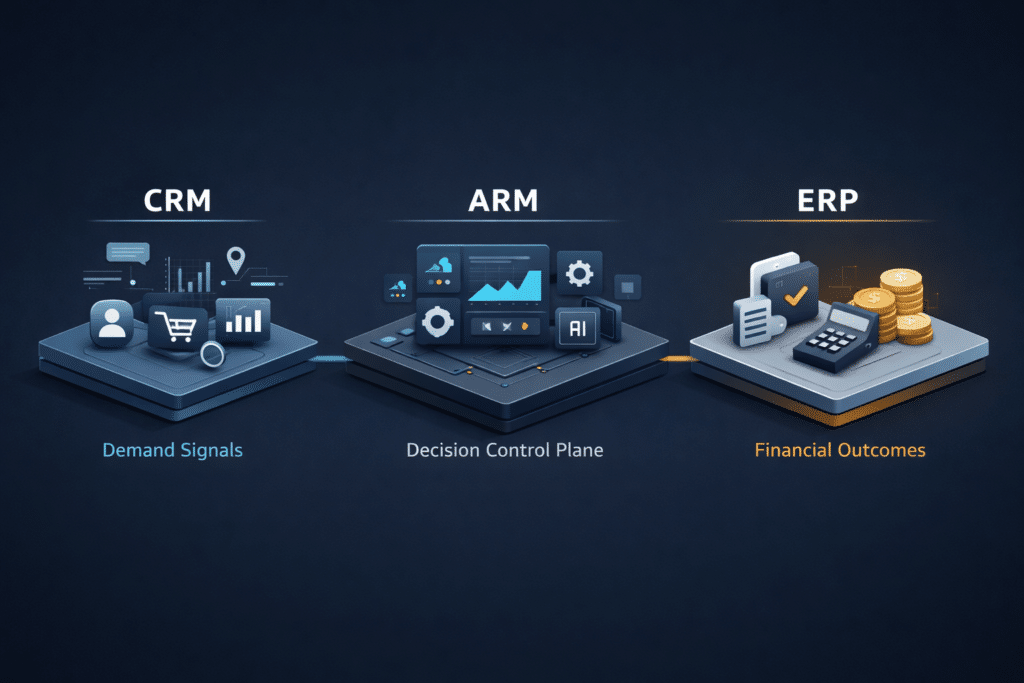
CRM captures demand and customer context.
ARM governs commercial intent, pricing logic, and policy.
ERP executes financial truth.

Each system does what it’s best at — no more, no less.

This separation reduces delivery risk, accelerates change, and builds trust between commercial and finance teams. It also avoids the downstream failures that often appear when billing and recognition are forced to absorb commercial complexity — a breakdown we unpack in Billing Is Where Revenue Transformations Go to Die.

In an ERP vs ARM revenue control model, this separation is what allows speed and governance to coexist.
Why This Matters Even More With AI and Agents

As organisations introduce AI and agent-led workflows, ambiguity becomes a liability.

By design, agents move fast. If logic is duplicated or ownership is unclear, errors scale quickly and accountability becomes harder to trace.

In this world, ARM acts as the control plane — ensuring decisions remain within defined commercial guardrails before execution in ERP.

ERP remains the system of record, while ARM becomes the system of decision.

That distinction is what enables speed without sacrificing control.

There Is No Universal Architecture

Some organisations extend their existing stack. Others replace specific components. Many land somewhere in between.

The right answer depends on how your business sells, how much flexibility you need, and where governance must sit.

At Trigg, we help leadership teams design revenue operating systems that reflect reality — complementing existing technology where it works, and replacing it where it doesn’t.

The goal is not consolidation for its own sake. Instead, it is clarity.

Executive Takeaway

Ultimately, ERP is essential to revenue transformation.
However, it is not the control plane.

Treating it as such slows innovation and increases risk — the opposite of what leaders intend.

The goal is not fewer systems. Rather, it is clear responsibility, governed autonomy, and a revenue operating model built for scale.

Designing Your Revenue Control Plane

Every organisation starts from a different place.

Some need clearer ownership across CRM, ARM, and ERP.
Others need to modernise legacy commercial layers.
Many need an operating model that is ready for AI-driven execution.

At Trigg, we help organisations define and implement revenue operating systems that scale — with governance designed in from day one.

If you’re reassessing revenue architecture, start with clarity — not consolidation.
Request a Revenue Operating System Assessment today.

Header illustration showing a stylised enterprise transformation with glowing systems and divergent human behaviour pathways.

Why Change Management Is the Hardest Part of Transformation

February 13th, 2026 Posted by AI, Insights, Revenue Management, Sales, Sales Automation 0 thoughts on “Why Change Management Is the Hardest Part of Transformation”

Most revenue transformations don’t fail in technology.
They fail in behaviour.

New platforms go live. Automation works. Dashboards light up. Yet months later, the same patterns reappear: sales teams bypass the system, deal desks quietly return, finance runs shadow controls, and AI agents are switched off or ignored.

This isn’t resistance.
It’s what happens when organisations fail to design change properly.

At Trigg, we see revenue transformation fail not because the platform is wrong — but because decision ownership, autonomy, and governance are never designed together.

Software executes decisions. Behaviour determines whether those decisions stick.

Transformation Fails in Behaviour, Not Software

Modern transformation programmes are very good at shipping systems.

They are far less effective at reshaping behaviour.

Dashboards lighting up does not mean teams have changed how they make decisions.
Automation running does not mean teams trust the system.
AI can make recommendations, but people won’t follow them without trust.

What breaks isn’t the tooling — it’s the gap between how decisions are supposed to be made and how people actually make them under pressure.

That gap is a change-management problem.

Minimalist isometric illustration of an enterprise revenue system: clean, glowing dashboards and automated workflows flow through a structured system, while muted, branching paths show manual overrides and shadow processes diverging from the core, with billing and revenue still converging intact in a modern, abstract corporate style.

Revenue Transformation Changes Decision-Making

Agentic revenue models don’t just improve efficiency. They change who decides.

Who can approve pricing.
When exceptions are allowed.
How renewals are triggered.
Which actions happen without human involvement.

That’s not just a system change — it reshapes the organisation.

When leaders don’t make decision boundaries explicit, teams default to familiar behaviours. Not out of defiance, but because ambiguity feels risky in revenue-critical moments.

Why Traditional Change Management Breaks Down

Most change programmes assume roles stay broadly the same, systems support people, and governance remains static.

Agentic revenue breaks all three assumptions.

Agents recommend, initiate, and enforce actions automatically. Without deliberate design, teams experience this shift as a loss of control rather than progress. People push back quietly by creating workarounds instead of confronting the change.

This is why revenue transformations most often collapse at the point of billing and execution — not strategy.

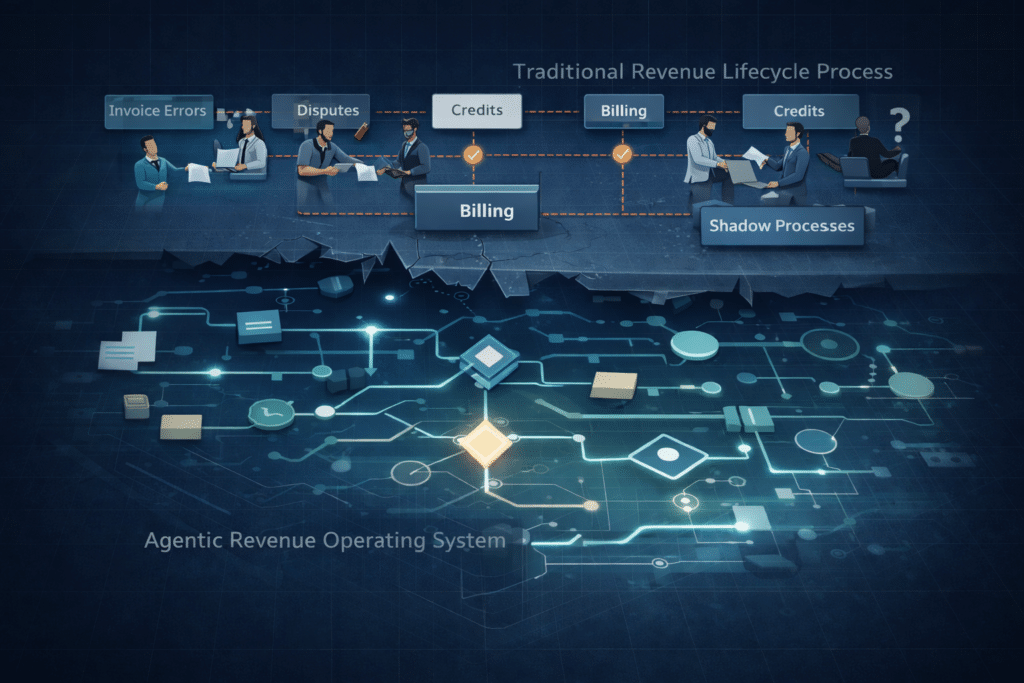
Isometric illustration comparing a traditional revenue lifecycle with an agentic revenue operating system, showing manual handoffs, people, approvals, and shadow processes above, and an automated, connected decision network operating beneath.

The Signals Change Was Never Designed

When organisations fail to manage change at the decision level, the same symptoms appear.

Sales teams create “one-off” exceptions that quickly become the norm.
Deal desks grow instead of shrinking.
A single unexplained AI decision undermines trust in the entire model.

Technology isn’t the problem. They signal that the organisation never adapted to the new way teams make decisions.

What Effective Change Looks Like in Practice

Successful organisations treat change management as a design discipline, not a communications exercise.

They make decision rights between humans and agents explicit. They introduce autonomy gradually, earning trust over time rather than demanding it at go-live.

And they focus on adoption as behaviour change, not feature usage.

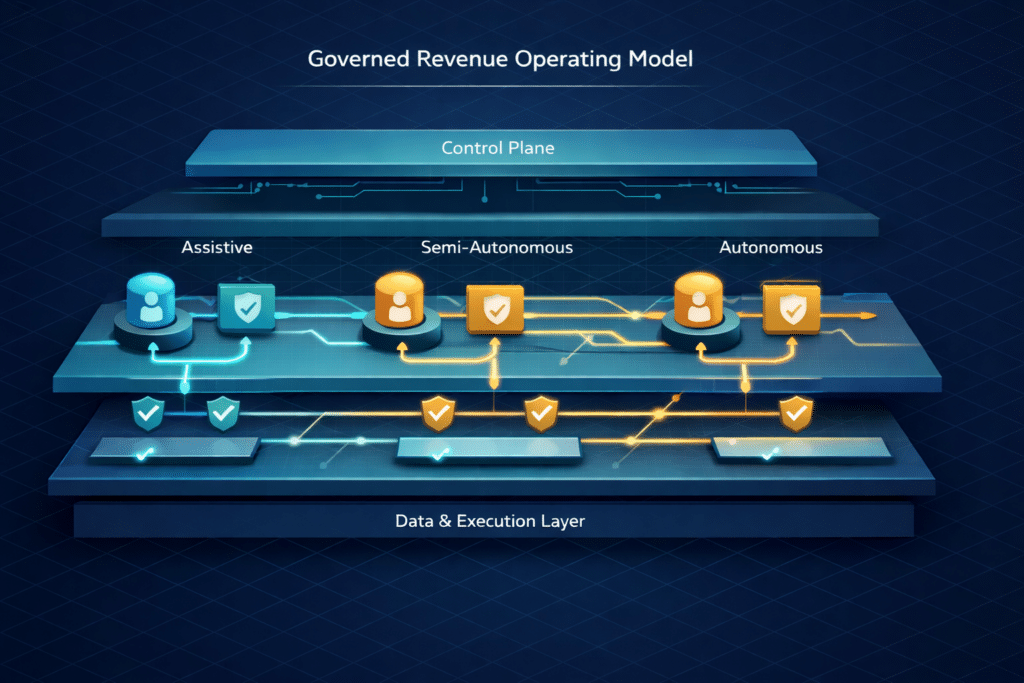
Isometric diagram of a governed revenue operating model showing a layered control plane above assistive, semi-autonomous, and autonomous decision flows, with structured pathways, validation checkpoints, and balanced left-to-right progression on a dark blue grid.

The Leadership Imperative

Leaders cannot delegate change management.

When leaders remain ambiguous about agent-based revenue models, teams read that ambiguity as permission to revert. Visible executive sponsorship — of decision boundaries, accountability, and new ways of working — is what makes agentic revenue stick.

Executive Takeaway

Revenue transformation fails when organisations automate execution without first designing how decisions are made. Effective transformation requires leaders to:

  • Make decision rights explicit across humans and agents
  • Introduce autonomy progressively, with trust earned over time
  • Embed governance upstream in the operating model, not after execution

When behaviour, governance, and systems are designed together, transformation becomes durable.

When they are not, teams revert to workarounds — regardless of how advanced the technology is.

This is the design principle behind how Trigg helps organisations build governed, agent-ready revenue operating models — where change is engineered into the system, not left to chance.

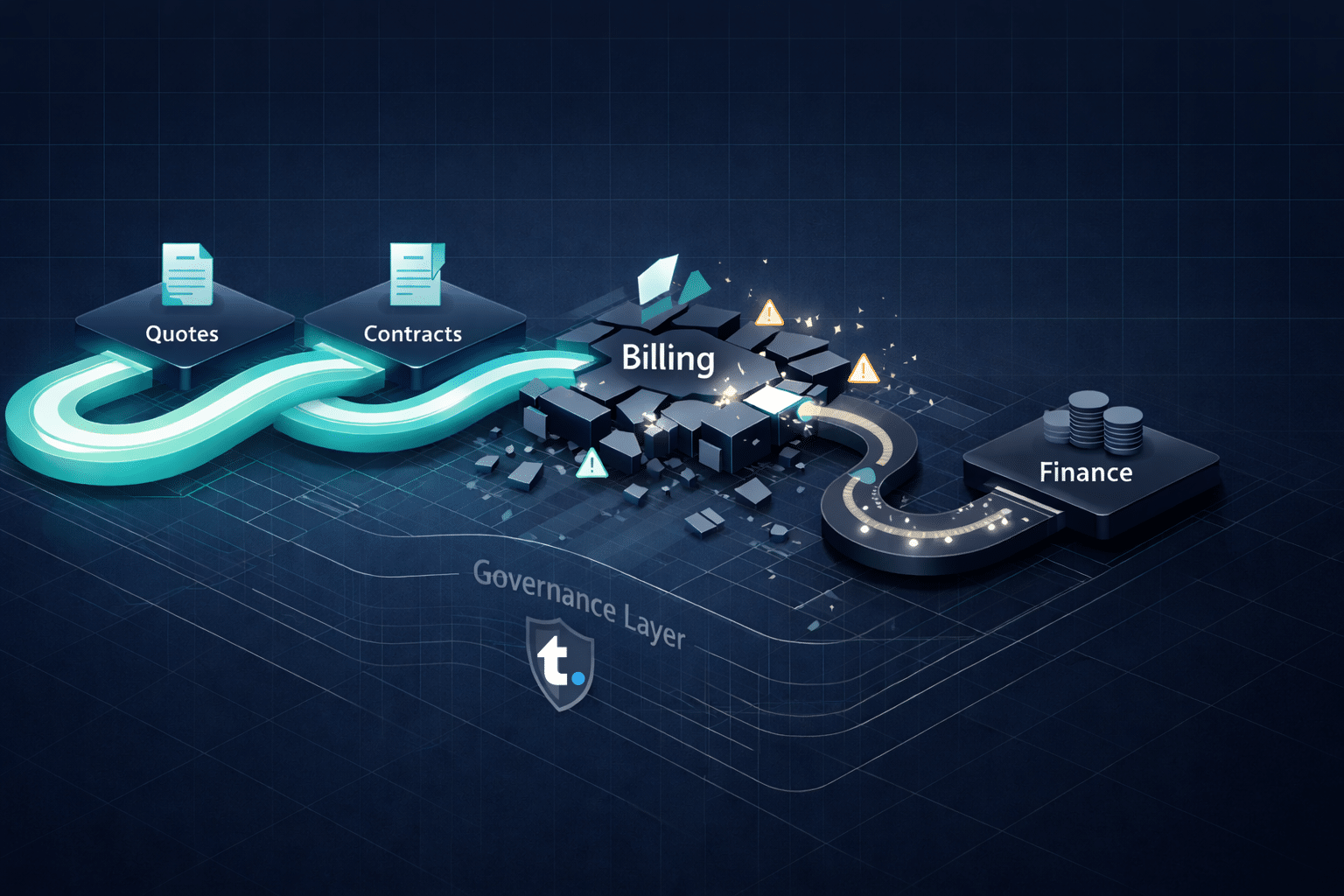
Isometric illustration showing a governed revenue lifecycle from quotes to contracts, billing, and finance, with validation checkpoints and a central control layer ensuring accuracy and compliance.

Billing Is Where Revenue Transformations Go to Die

February 9th, 2026 Posted by AI, Insights, Revenue Management, Sales, Sales Automation 0 thoughts on “Billing Is Where Revenue Transformations Go to Die”

Most revenue programmes look successful at go-live.

In a billing revenue transformation, that confidence often holds — until billing starts.

Quotes are faster.
Sales adoption is high.
Dashboards look impressive.

However, billing starts.

Invoices don’t match expectations.
Credits pile up.
Disputes consume Finance and Sales alike.

And quietly, confidence in the entire transformation erodes.

What looked like progress begins to feel fragile. Not because the vision was wrong — but because the hardest part of revenue was deferred.

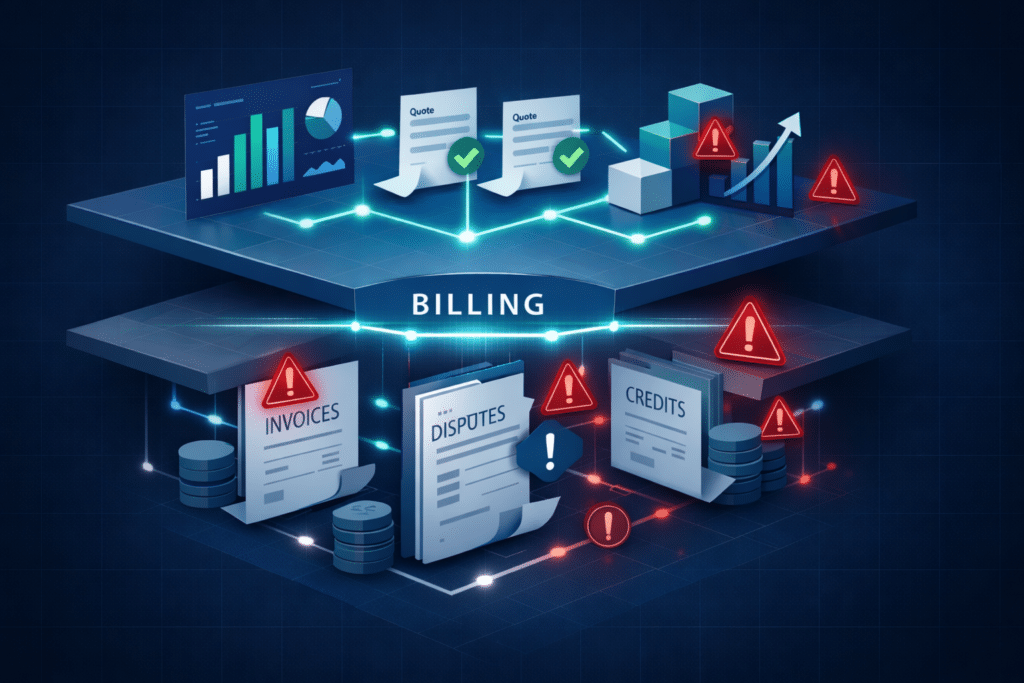
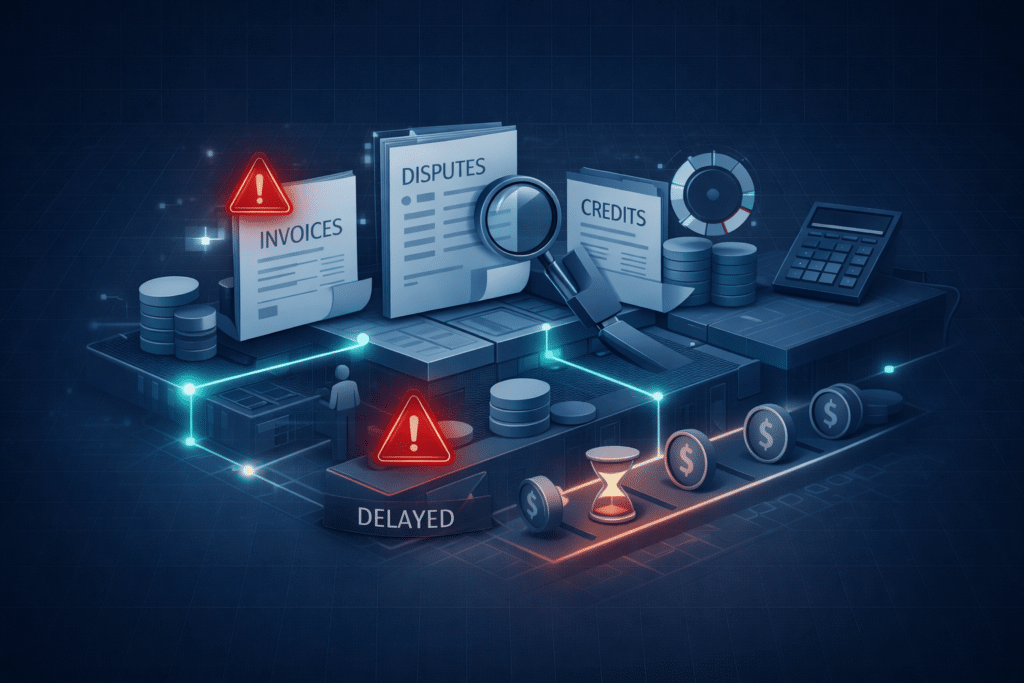
Isometric illustration showing billing as the central checkpoint in the revenue lifecycle, where approved quotes and growth metrics surface downstream issues such as invoice errors, disputes, and credits.

Why CFO Confidence Collapses at Billing

From a finance perspective, most revenue transformations don’t fail because automation was a bad idea — they fail because billing is where risk finally becomes visible.

Upstream, everything looks healthy:

  • Forecasts assume best-case behaviour
  • Automation accelerates pricing and approvals
  • Dashboards signal progress and adoption

But once billing begins, Finance inherits decisions that are already locked:

  • Pricing logic is fixed
  • Discounting behaviour is entrenched
  • Billing complexity is unavoidable

At that point, invoices stop matching expectations.
Credits accumulate.
Disputes multiply.

What looked like momentum upstream becomes exposure downstream.

CFO scepticism isn’t resistance to change.
It’s resistance to uncontrolled, unrecoverable risk.

Finance isn’t reacting to automation — it’s reacting to the moment when upstream decisions become financially irreversible.

This pattern is explored in more depth in our CFO’s Guide to Agentic Revenue, which looks at how governed autonomy prevents these downstream failures before they reach billing.

Why Billing Breaks Revenue Transformation

Billing rarely gets attention early because:

  • It’s complex
  • It’s cross-functional
  • It doesn’t feel “strategic”

These factors push billing downstream in programme design — even though it’s the first place customers and cash feel the impact.

Yet billing is where revenue intent becomes customer reality.

Every discrepancy is visible.
Each error damages trust.
Over time, disputes delay cash.

If revenue is an operating system, billing is its moment of truth.

The Hidden Cost of Billing Failure

Isometric illustration showing billing-related invoices, disputes, and credits creating operational drag and delayed cash flow across finance and revenue teams.

When billing isn’t deliberately designed into revenue transformation, the consequences cascade:

  • Finance absorbs manual effort
  • Sales firefights instead of selling
  • Customers lose confidence
  • Cash cycles lengthen

As a result, none of these show up clearly in the original business case.

All of them show up in month-end close.

Worse, teams often blame these failures on “process” or “training” — rather than the architectural gaps that created them.

Why Legacy Models Break Down

Traditional revenue models assume:

  • Billing follows contracting cleanly
  • Products behave predictably
  • Usage changes are rare

In practice, those assumptions no longer hold.

Modern revenue violates all three.

Subscriptions upgrade mid-term.
Usage fluctuates daily.
Entitlements change continuously.

Without a system that deliberately orchestrates these changes, billing chaos isn’t an exception — it’s the default.

The Role of ARM in Billing Revenue Transformation

Agentforce Revenue Management doesn’t always replace billing systems.

It makes them reliable.

ARM creates a governed layer between commercial intent and financial execution by governing what can be sold, tracking changes to entitlements, coordinating amendments and renewals, and explaining billing outcomes transparently.

As a result, ARM reduces invoice errors, credit volumes, and dispute cycles — while improving customer trust, cash predictability, and finance credibility.

Billing stops being reactive — and becomes explainable.

That explainability is what allows Finance to trust automation at scale.

Billing Is a Design Problem, Not an Execution One

Most billing failures don’t originate in billing.

They originate in upstream decisions that were optimised for speed rather than control.

Common root causes include unclear pricing logic, inconsistent amendment handling, and missing policy enforcement.

By contrast, fixing billing downstream is expensive.

Designing revenue correctly upstream is not.

What Leaders Get Wrong

The most dangerous assumption in revenue programmes is simple:

“We’ll fix billing later.”

By that point, trust has already been lost.

Leaders must co-design billing with pricing, contracts, and agents — or billing will expose every shortcut taken upstream.

Executive Takeaway

You can automate quoting.
You can optimise contracts.
And you can deploy agents.

But if billing doesn’t work, none of it matters.

If billing feels fragile, it’s usually because revenue was designed for speed before it was designed for control.

The organisations that scale confidently treat billing as a design decision — not a downstream fix.

If this resonates and you’re reassessing how billing, pricing, contracts, and automation fit together, get in touch with the team at Trigg.

Agentforce Revenue Management: The Missing Control Plane Between CRM and ERP

January 19th, 2026 Posted by Insights, Revenue Management, Sales, Sales Automation 0 thoughts on “Agentforce Revenue Management: The Missing Control Plane Between CRM and ERP”

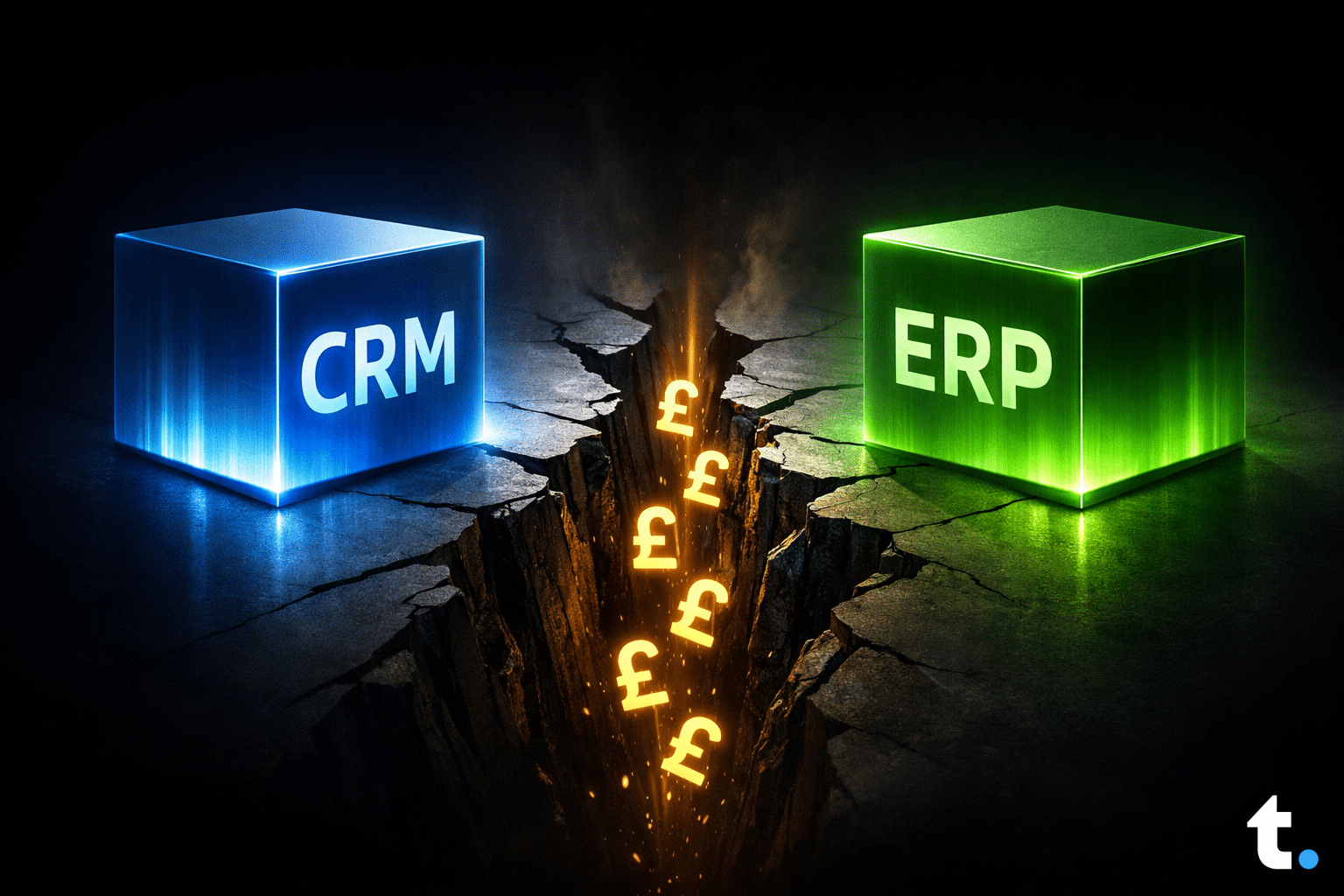
Agentforce Revenue Management (ARM) provides the revenue control plane enterprises need between CRM and ERP. Most enterprises already run two powerful systems:

CRM captures demand.
ERP records financial truth.

Yet revenue still leaks.

Deals stall.
Billing disputes rise.
Finance questions pipeline confidence.

The problem isn’t system capability.

Instead, neither platform was designed to orchestrate revenue end to end.

The False Choice: CRM or ERP Owning Revenue

When revenue breaks, organisations swing between two extremes. One camp argues that sales should own it and push everything into CRM. Meanwhile, the other insists finance should take control and lock everything down in ERP.

Both approaches fail — and they fail for the same reason.

No single function owns revenue. Instead, revenue operates as a cross-functional system built on three elements: intent, decisioning, and execution.

CRM captures what customers want. However, ERP records what actually happened.

As a result, organisations lack real-time control.

What’s missing is a revenue control plane — a layer that governs what can happen before execution begins.

The Messy Middle Between CRM and ERP

Between CRM and ERP sits the most fragile layer of revenue operations. Here, teams define pricing logic, govern discounts, manage contracts, handle renewals, apply usage changes, and hand off billing.

As a result, margin gets negotiated, risk increases, and exceptions multiply.

Historically, organisations stitched this layer together with CPQ rules, manual approvals, spreadsheets, and deal desks. At the time, this approach felt “good enough.”

However, it no longer scales.

Today, subscriptions, consumption pricing, global revenue models, and AI-driven decisions demand real-time control. Therefore, complexity has outgrown the tooling.

Why Revenue Needs a Control Plane

Modern enterprises don’t just need more automation. Instead, they need a revenue control plane.

This system coordinates decisions across Sales, Finance, Legal, and Operations. It enforces commercial policy dynamically and translates customer intent into execution.

This is exactly what Agentforce Revenue Management delivers.

ARM doesn’t replace CRM or ERP. Instead, it sits between them to orchestrate revenue with speed and governance.

As a result, leaders make the right decisions before execution — not after.

What Is Agentforce Revenue Management?

Agentforce Revenue Management (ARM) is Salesforce’s revenue orchestration layer. Its role is to own commercial intent, validate deals against policy and margin rules, and orchestrate execution into billing and finance systems.

ARM is not CPQ v2. It’s not a billing engine. And it’s not a reporting layer. It’s a control system.

In practice, CRM captures what the customer wants. ARM governs what the business allows. ERP records what gets booked and billed.

This structure removes friction, reduces risk, and dramatically improves forecast confidence.

Agentforce Revenue Management and AI Agents

As AI agents take on more responsibility — from creating quotes and managing renewals to resolving billing queries — the risk of unguided automation increases.

Without a revenue control plane, agents act on incomplete data, finance loses visibility, and trust starts to erode. Automation moves faster than governance, and that’s where things break.

Agentforce Revenue Management provides the guardrails that allow automation to scale safely. It ensures AI-driven actions are aligned with commercial policy, financial controls, and enterprise risk standards.

For a deeper view on modern revenue architecture, explore our guide to the Revenue Operating System.

Executive Takeaway

If revenue still feels unpredictable, slow, or contested internally, it’s rarely a people problem. It’s almost always an architecture problem.

Until organisations design a revenue control plane between CRM and ERP, they will continue to leak value through friction, exceptions, and manual workarounds.

The future of revenue isn’t owned by Sales or Finance.

It is orchestrated — deliberately — through Agentforce Revenue Management.

Ready to take control of revenue?
See how Agentforce Revenue Management delivers real-time governance across every deal, renewal, and billing event. Book a strategy session to see ARM in action.

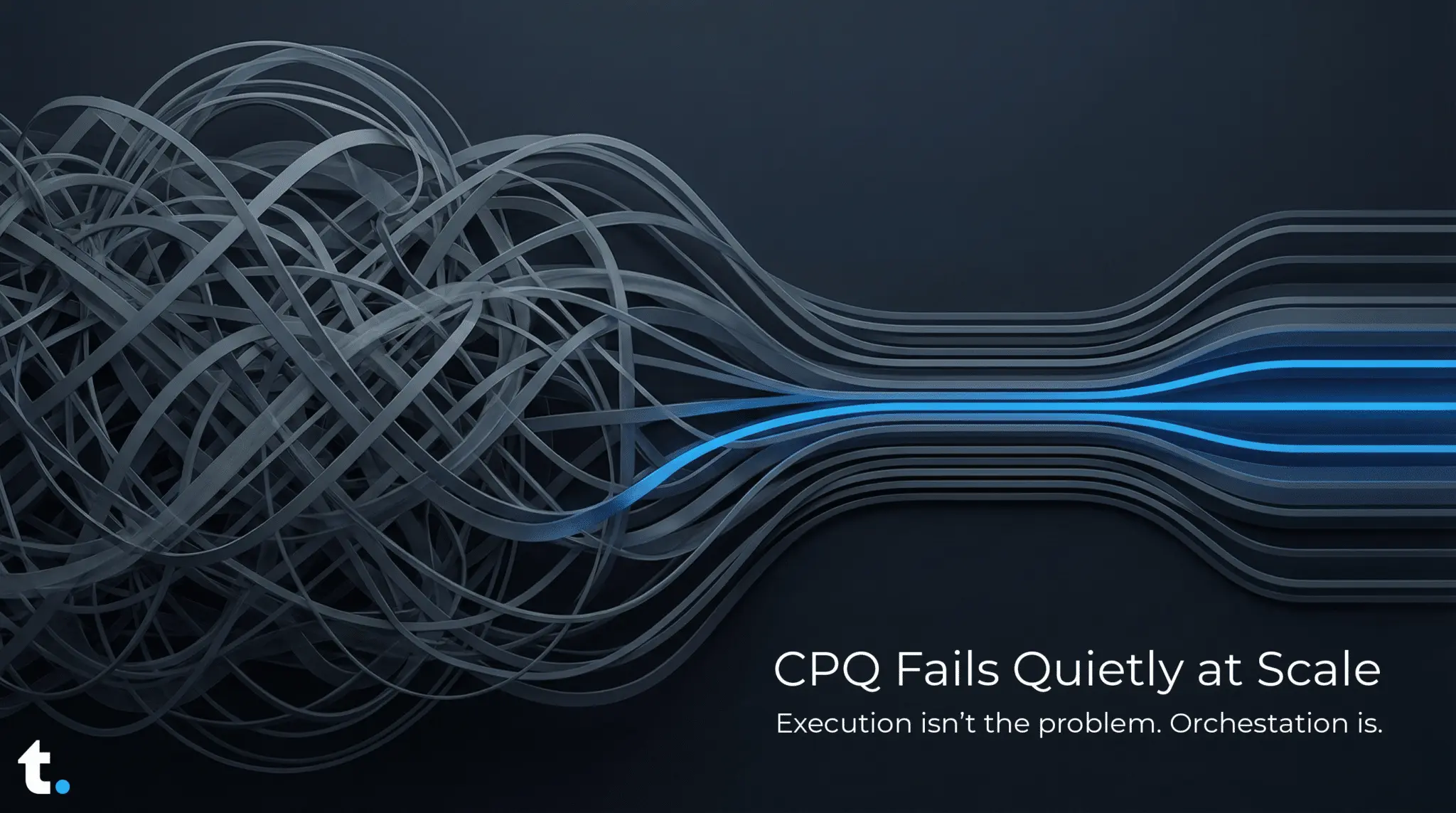
Abstract enterprise system visual showing tangled, layered flows on the left gradually resolving into clean, parallel lines on the right, symbolising the shift from CPQ complexity to governed orchestration and decision clarity.

Why Most CPQ Programmes Fail at Scale (And What Replaces Them)

January 12th, 2026 Posted by Insights, Revenue Management, Sales, Sales Automation 0 thoughts on “Why Most CPQ Programmes Fail at Scale (And What Replaces Them)”

CPQ at scale rarely fails dramatically.
It doesn’t crash.
Nor does it get ripped out overnight.
And it rarely triggers a transformation programme on day one.

Instead, it degrades.

Quietly.

Not because CPQ is outdated — but because revenue has outgrown it.

As product portfolios expand, pricing models multiply, and revenue becomes more dynamic, CPQ shifts from enabler to constraint — not because the technology is poor, but because the role it’s been asked to play has fundamentally changed.

The Warning Signs Are Subtle — Until They Aren’t

In practice, most organisations don’t wake up one morning and declare their CPQ broken. Instead, the signals emerge slowly:

🧾 Quotes still go out — but take longer than they used to
🧩 Exceptions increase — and quietly become “normal”
🔍 Finance validates after close — not before
🧑‍💼 Deal desks grow — instead of shrinking
📉 Margin erosion appears later — not in the moment

Individually, these look like operational issues.

Collectively, they signal something structural — revenue decisions are being forced through a system designed for a simpler world.

These are the early indicators of CPQ being stretched beyond its design limits.

What CPQ Was Actually Built to Do

Originally, CPQ was designed to answer a narrow set of questions:

Is this configuration valid?
Does the price follow the rules?
Can sales generate a quote quickly and consistently?

That worked when:

📦 Products were largely static
📊 Pricing models were predictable
🧭 Sales owned most decisions
🧾 Billing followed contracting with minimal deviation

In that environment, CPQ automated execution effectively.

But modern revenue no longer fits inside those assumptions.

Today’s reality includes subscriptions, usage, amendments, renewals, mid-term changes, regional overlays, and continuous optimisation — all happening simultaneously.

CPQ was never designed to orchestrate that level of dynamism.

Where Scale Turns CPQ Into a Bottleneck

As complexity rises, the same failure modes appear across industries when CPQ at scale becomes the de facto decision engine.

Logic becomes fragile
Pricing rules pile up. Bundles nest inside bundles. Small changes carry unexpected consequences.

Trust erodes
Sales, finance, and billing interpret the same deal differently — and stop relying on a single source of truth.

Speed declines
Approvals multiply. Manual intervention increases. Automation paradoxically slows things down.

AI adds risk instead of leverage
When AI is bolted onto an unstable decision model, confidence drops instead of rising. Governance becomes reactive.

The shift requires agent-based execution that operates inside clearly defined policy, pricing, and risk boundaries — not alongside them.

Real value only emerges when agents operate inside defined policy, pricing, and risk boundaries — not alongside them.

None of this is a tooling problem.

It’s an operating-model problem.

The Real Shift: CPQ as a Component, Not the Brain

High-performing organisations aren’t “replacing CPQ”.

They’re demoting it.

They recognise that CPQ can’t sit at the centre of revenue decision-making. Instead, it needs to operate inside a broader revenue orchestration layer — one that:

🎛️ Governs pricing and policy centrally
🔄 Aligns sales intent with financial outcomes continuously
🤝 Defines where humans decide and where agents act
⚠️ Exposes risk before revenue is committed

In this model, CPQ executes — but it doesn’t decide.

Why This Isn’t Just Another CPQ Upgrade Cycle

Crucially, this isn’t CPQ v2.
It isn’t “CPQ plus AI”.
And it isn’t a better approval workflow.

It’s a recognition that revenue no longer behaves like a linear transaction flow.

It behaves like a system — adaptive, always on, and constantly recalculating.

Trying to manage that with tools designed for sequential handoffs guarantees friction, delay, and leakage.

What Leaders Need to Confront

Most CPQ programmes don’t fail at launch.

They fail over time — as complexity accumulates and confidence drains away.

The organisations pulling ahead are the ones willing to:

🚫 Stop treating revenue as a sales automation problem
🧠 Design decision-making, not just execution
🏛️ Embed finance, governance, and AI by design
🧩 Rethink the layer between CRM and ERP — where orchestration platforms like Agentforce Revenue Management increasingly sit — but where operating-model clarity is still missing

This is where we see transformation succeed — or stall.

Because revenue transformation is no longer a sales initiative.

It’s an enterprise design challenge.

Closing Thought

CPQ at scale still matters. But it can no longer be the place where revenue decisions live.

The future belongs to organisations that design for complexity first — and let CPQ play the role it was always meant to play:

Execution, not orchestration.
Control, not complexity.

Abstract visual showing converging signals forming a stabilised horizontal control plane, representing non-linear revenue flows.

Revenue Is No Longer a Process — It’s an Operating System

January 7th, 2026 Posted by Insights, Revenue Management, Sales, Sales Automation 0 thoughts on “Revenue Is No Longer a Process — It’s an Operating System”

For decades, enterprises treated revenue as a process.

Lead to opportunity. Quote to contract. Order to invoice.

Linear, sequential, and comfortably predictable.

That mental model is now breaking down — because revenue no longer behaves like a workflow you move through once. It behaves like an operating system: always on, continuously recalculating, and governing decisions in real time.

Today’s revenue environment is shaped by subscription and usage-based models, sprawling product portfolios, multiple regions and channels, and an ever-tightening web of finance, compliance, and margin constraints. At the same time, automation and Agentic AI are no longer optional — they are actively shaping how commercial decisions are made.

Trying to force this reality through yesterday’s Quote-to-Cash logic is like running cloud workloads on a mainframe. It technically works — until it doesn’t.

And when it breaks, it breaks expensively.

The Real Problem Isn’t Sales or Finance

It’s the Messy Middle

When revenue leaders describe where things go wrong, the symptoms are remarkably consistent.

Quotes take too long to produce. Approvals stack up. Renewals fail to capture full value. Billing disputes erode customer trust. Finance teams hesitate to rely on the numbers until weeks after the deal is done.

What’s striking is that none of this friction truly lives in CRM or ERP.

It lives in the space between them.

That “messy middle” — pricing logic, discounting rules, contract structures, amendments, order changes, billing hand-offs — is where an estimated three to seven percent of revenue quietly leaks away.

It’s where deal velocity slows, margins drift off policy, and governance becomes reactive rather than intentional.

Traditional CPQ tools were built to configure products and generate quotes. They were never designed to orchestrate revenue at enterprise scale, across constantly shifting commercial conditions.

Why Linear Quote-to-Cash Has Reached Its Limit

The original Quote-to-Cash model was designed for a very different world.

It assumed humans made most decisions, products rarely changed, pricing was largely predictable, and billing happened after the “real work” of selling was done.

None of those assumptions hold today.

Modern revenue demands continuous recalculation, live validation, dynamic pricing and packaging, and constant alignment between sales intent and financial reality. Revenue no longer behaves like a checklist you complete once — it behaves like a living system that is always in motion.

Linear Quote-to-Cash models struggle not because they are poorly implemented, but because they were never designed to operate as a governed revenue operating system under constant change.

When organisations try to force complexity through a linear flow, it doesn’t disappear. It simply re-emerges later as risk, rework, and revenue leakage.

Revenue as an Operating System: Why the Revenue Operating System Matters

The organisations pulling ahead are not just optimising individual steps in the process. They are redesigning how revenue itself operates.

They are building a revenue operating system — one designed to govern decisions, not just execute transactions.

Not a single tool, but a governing layer that determines:

  • how commercial decisions are made
  • who makes them (human or agent)
  • when decisions escalate
  • how intent moves cleanly into financial execution


In this model:

  • CRM captures demand
  • ERP records financial truth
  • the revenue layer in between coordinates pricing, policy, governance, and execution — live


This is where agent-based systems become genuinely transformational. Not because they automate isolated tasks, but because they manage complexity at speed, with governance designed in rather than bolted on.

It’s why many enterprises are now re-examining their revenue architecture — shifting focus away from individual tools and toward the operating layer that connects them.

This architectural approach increasingly aligns with how modern platforms describe enterprise revenue management: as a governed, real-time layer sitting between CRM and ERP.

What This Means for Leaders

If revenue is now an operating system, then CPQ on its own is no longer enough.

AI added after the fact introduces risk rather than control. Finance, billing, and governance can no longer sit downstream — they must be part of the design from day one.

Most importantly, revenue transformation is no longer a sales initiative.

It is an enterprise design challenge.

One that sits at the intersection of commercial strategy, financial governance, data, and automation — and one many organisations are only just beginning to confront.

Closing Thought

The next generation of market leaders won’t win because they quote faster.

They’ll win because they run revenue as a real-time, governed operating system — designed for complexity, resilience, and scale, rather than nostalgia.

A long straight road with a beautiful sunset behind it

Retail Media: Building A Seamless Customer Journey For Your Advertisers

November 24th, 2022 Posted by Insights, Media, Retail, Retail Media 0 thoughts on “Retail Media: Building A Seamless Customer Journey For Your Advertisers”

The 8 key steps to ensure you’re offering a seamless customer journey in your retail media network.