Marketplaces Archives - Trigg Digital

Posts in Marketplaces

Scaling the Marketplace Engine for Merchant Growth at Kingfisher

June 1st, 2026 Posted by Enterprise, Marketplaces 0 thoughts on “Scaling the Marketplace Engine for Merchant Growth at Kingfisher”

CASE STUDY

Scaling the Marketplace Engine for Kingfisher’s Data-Driven Transformation

Kingfisher plc is a leading home improvement retailer operating iconic brands including B&Q, Screwfix, Castorama and Brico Dépôt across the UK and Europe. Serving both consumers and trade customers at scale, Kingfisher continues to invest in data-led growth and operational efficiency across its retail, marketplace and retail media initiatives.

Kingfisher partnered with Trigg Digital to simplify its Salesforce ecosystem and create a scalable platform to support marketplace expansion, retail media growth, and improved customer and merchant experiences.

INDUSTRY & SEGMENT

Retail Enterprise


Platform & products
Agentforce Sales Agentforce Service Marketing Cloud Experience Cloud Data 360 CRM Analytics

The Challenge

Over time, Kingfisher’s Salesforce landscape had grown increasingly complex, creating operational friction and limiting the organisation’s ability to fully leverage its data and digital capabilities.

Key challenges included:

  • Legacy technical debt and architectural complexity across multiple Salesforce platforms
  • Fragmented data and integrations preventing a consistent view of customer and commercial activity
  • Manual and duplicated processes across merchant onboarding, marketing activation, retail media operations and reporting workflows
  • Limited confidence in performance insight and ROI measurement across campaigns and marketplace initiatives
  • A need for a comprehensive architectural and operating model review to enable sustainable growth across retail, marketplace and retail media

These challenges created operational inefficiencies and made it difficult for teams to act on data-driven insights with confidence.

Our Approach

Working closely with Kingfisher, Trigg Digital delivered a strategic advisory and architecture transformation programme focused on simplifying the Salesforce ecosystem and enabling scalable, data-driven operations.

Our approach included:

Salesforce architecture review and transformation roadmap
A comprehensive assessment of Kingfisher’s Salesforce environment to define a simplified, scalable architecture and long-term transformation roadmap.

Unified data foundation
Design of a governed data architecture using Salesforce Data Cloud combined with Databricks Zero-Copy capabilities to create a trusted and unified data foundation.

Customer engagement modernisation
Deployment of Salesforce Marketing Cloud Advanced to support more personalised customer engagement and campaign execution.

Operational performance visibility
Implementation of CRM Analytics to provide near real-time reporting across marketplace performance, marketing campaigns and commercial operations.

Future-ready platform architecture
Design of a modular platform architecture capable of supporting future data, AI and automation initiatives.

In Their Words

“A pivotal step forward in Kingfisher’s journey to deliver smarter and more connected experiences for our merchants. By leveraging Trigg Digital’s deep Salesforce, AI, retail, marketplace, and retail media expertise, we’re unlocking new opportunities to accelerate growth. Together, we’re building the future of home improvement.”

David Gomez, Group Marketplace Director, Kingfisher

The Results

IMPROVED EMPLOYEE EXPERIENCE

Simplified processes and improved system usability reduced operational friction, enabling teams to work more efficiently and focus on higher-value activities.

BETTER MERCHANT AND PARTNER EXPERIENCE

Improved data visibility and streamlined workflows strengthened collaboration with marketplace partners and improved merchant engagement.

INCREASED CONFIDENCE IN DATA AND PERFORMANCE INSIGHTS

Near real-time reporting and unified data improved visibility into campaign performance, marketplace activity and commercial outcomes.

REDUCED PLATFORM RISK

Architectural optimisation reduced platform risk and technical rework by approximately 20–30%, creating a more stable and resilient foundation.
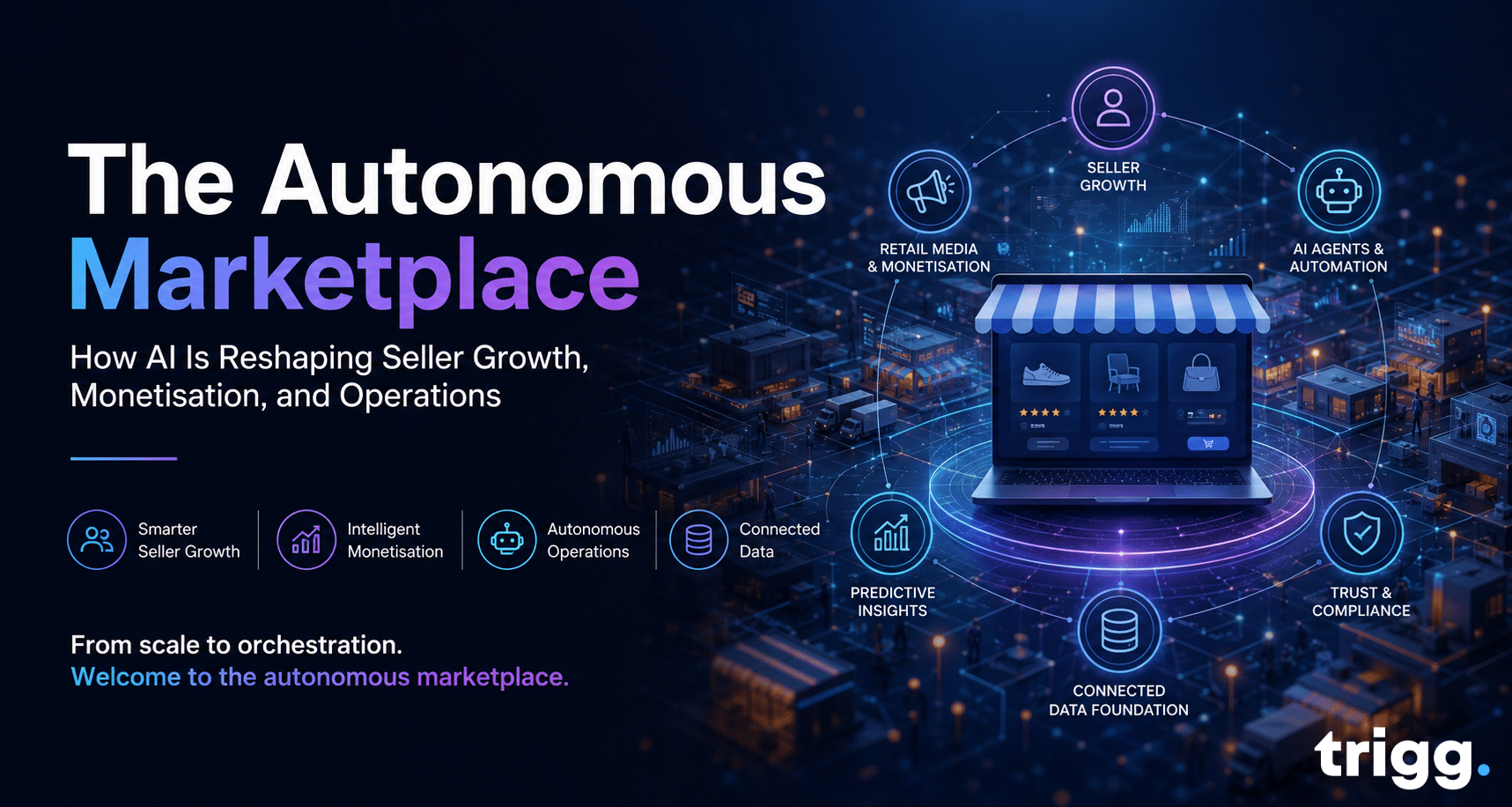

The Autonomous Marketplace: How AI Is Reshaping Seller Growth, Monetisation, and Operations

May 12th, 2026 Posted by Insights, Marketplaces, Retail 0 thoughts on “The Autonomous Marketplace: How AI Is Reshaping Seller Growth, Monetisation, and Operations”

Marketplaces spent the last decade chasing scale. The next decade belongs to orchestration. Discover how AI, connected data, and autonomous agents are reshaping seller growth, retail media, monetisation, and platform operations.

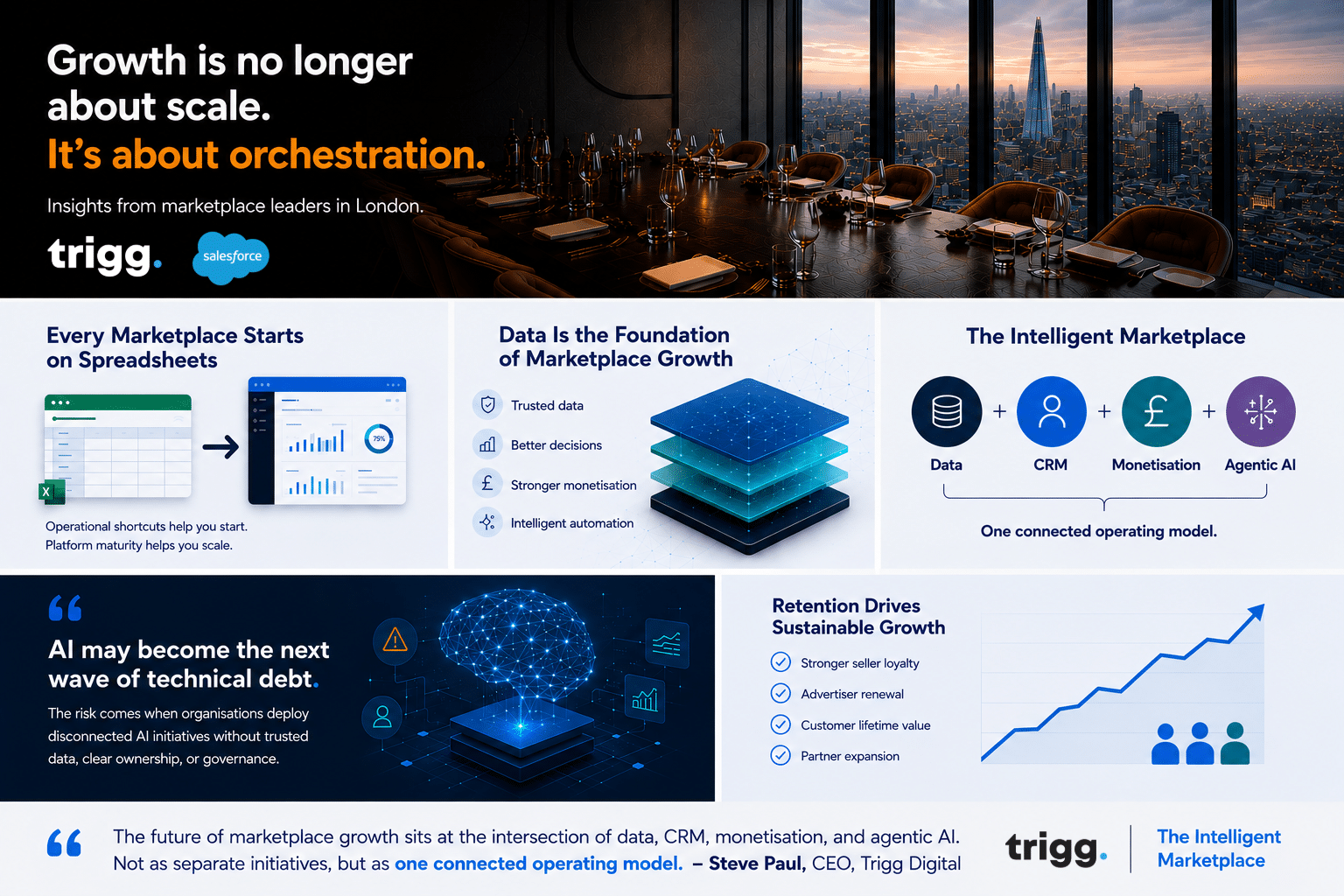
Marketplace growth strategy executive lunch in London with the message growth is no longer about scale, it’s about orchestration

Marketplace Growth Is No Longer About Scale. It’s About Orchestration.

May 11th, 2026 Posted by Insights, Marketplaces, Retail 0 thoughts on “Marketplace Growth Is No Longer About Scale. It’s About Orchestration.”

Last week, together with our partners at Salesforce, Trigg Digital had the privilege of bringing together an exceptional group of leaders from across retail, marketplaces, classifieds, travel, payments, and digital commerce for an invitation-only executive lunch in London.

Hosted at Lucky Cat by Gordon Ramsay, the goal was deliberately simple: no presentations, no sales pitches, and no corporate theatre—just an honest conversation about where the next wave of marketplace growth is really coming from.

What followed was one of the most commercially grounded and strategically honest discussions we’ve had in some time. While every organisation around the table was at a different stage of maturity, one theme surfaced repeatedly throughout the afternoon:

Growth is no longer about scale.
It’s about orchestration.

For many years, marketplace growth was measured largely through volume. More sellers, more products, more categories, and more traffic were seen as the primary indicators of success. While scale still matters, scale alone is no longer enough. Today, scale is expected. The real differentiator is how effectively businesses orchestrate data, relationships, monetisation models, and increasingly, artificial intelligence.

One of the most relatable observations of the day came early in the discussion:

Key themes from Trigg Digital’s marketplace leadership discussion in London: operational maturity, trusted data, retention, and agentic AI.

Every Marketplace Starts on Spreadsheets

Every successful platform begins somewhere. In the early stages, spreadsheets, shared inboxes, manual approvals, and operational workarounds often provide the flexibility needed to move quickly. In fact, as we explored in our recent article, Seller Management: The Hidden Engine Behind Marketplace Growth, many marketplace businesses reach an inflection point where seller operations, onboarding, and partner workflows become just as critical as customer acquisition.

The challenge arises when these temporary processes become permanent infrastructure.

At a certain point, what once enabled growth begins to constrain it. Seller onboarding slows, approvals become fragmented, reporting becomes inconsistent, and operational visibility declines. The businesses scaling most effectively are recognising the moment when operational flexibility must evolve into platform maturity.

Another strong theme centred around strategic focus.

Winning Doesn’t Mean Owning Everything

As marketplaces grow, there is often pressure to expand into adjacent categories, launch new services, or pursue every possible revenue opportunity. However, some of the strongest perspectives shared during the event reinforced a different approach.

The most successful marketplace businesses are not trying to own every category. Instead, they are doubling down on areas where they already possess customer trust, supply-side advantage, audience density, and commercial differentiation. Sustainable growth does not always come from doing more. In many cases, it comes from doing fewer things—exceptionally well.

Perhaps the strongest operational theme of the afternoon was data.

Data Quality Is Now a Commercial Strategy

Retail media, dynamic pricing, personalisation, forecasting, and AI-driven decision-making all depend on trusted signals. Without clean, connected, and governed data, monetisation stalls, customer experiences become inconsistent, and commercial teams struggle to act with confidence.

Data quality is no longer an IT initiative. It is increasingly becoming a core revenue strategy.

The conversation also challenged a long-standing marketplace obsession with acquisition.

Retention and Expansion Matter as Much as Acquisition

Historically, marketplace businesses have focused heavily on bringing in new sellers, new buyers, and new inventory. Yet the leaders around the table repeatedly returned to a more difficult truth: sustainable growth comes from retention.

Seller loyalty, advertiser renewal, customer lifetime value, and partner expansion are becoming just as important as acquisition. The strongest businesses are not simply growing faster—they are compounding smarter.

As organisations scale, complexity inevitably follows.

Complexity Can Outpace Revenue

Every leader in the room acknowledged the same challenge. Growth creates more workflows, more integrations, more teams, more approvals, and more exceptions.

Left unmanaged, complexity quietly becomes technical debt.

The organisations scaling most effectively are not necessarily the largest. They are the ones building operating models that can scale with complexity, rather than against it.

Perhaps the boldest statement of the afternoon came during a discussion on artificial intelligence.

AI May Become the Next Wave of Technical Debt

This is not because AI itself is the problem. The risk comes when organisations deploy disconnected AI initiatives without trusted data, clear ownership, or governance.

Duplicate tools, fragmented decision-making, inconsistent outputs, and overlapping automation can quickly create complexity rather than advantage.

The marketplaces that will win over the next decade will not simply deploy AI. They will operationalise intelligence—built on trusted data, connected workflows, platform governance, and business ownership.

What Comes Next for Marketplace Growth Strategy?

If one thing became clear throughout the day, it is that the future of marketplace growth sits at the intersection of data, CRM, monetisation, and agentic AI—not as separate initiatives, but as one connected operating model.

At Trigg Digital, we call this The Intelligent Marketplace.

Because the question is no longer:

How big can your marketplace become?

The real question is:

How intelligently can it scale?

Special thanks to our partners at Salesforce and to every leader who contributed so openly throughout the day. The conversations reinforced just how much opportunity still lies ahead.

Re-thinking your marketplace growth strategy?

If you’re scaling a marketplace, retail media platform, or partner ecosystem, book a strategy conversation with Trigg Digital.

Seller Management: The Growth Engine Behind Scalable Marketplaces

March 2nd, 2026 Posted by Insights, Marketplaces, Retail 0 thoughts on “Seller Management: The Growth Engine Behind Scalable Marketplaces”

Seller management has quietly become one of the most powerful growth levers in modern marketplaces. Not because marketplaces list more products, but because—when seller participation is designed and managed well—they generate a continuous flow of high-quality, first-party signals. These signals increasingly shape discovery, conversion, engagement, and long-term growth.

This shift matters now more than ever. As marketplaces layer in retail media, promotions, fulfilment commitments, and monetisation models, growth increasingly depends on the quality and timeliness of seller-generated signals—not just the size of the catalogue.

In many organisations, seller management still sits in the background. Teams often treat it as a functional necessity that covers onboarding, catalogue uploads, compliance checks, and support tickets. In practice, however, seller management now plays a far more strategic role. It directly influences marketplace liquidity, data quality, and scalability.

As marketplaces mature and evolve into broader platforms, the way sellers are managed—and empowered—becomes decisive. Increasingly, it determines whether a marketplace compounds or plateaus.

Marketplaces Are No Longer Just Transaction Engines

Traditional ecommerce models optimise within a single organisation. Marketplaces operate very differently. Control is distributed across independent sellers, and outcomes emerge from how effectively participation is coordinated.

As a result, successful marketplaces no longer win by simply aggregating supply. Instead, they win by orchestrating participation.

Every seller interaction creates signals. Onboarding decisions, pricing updates, availability changes, and promotional activity all generate data points. Over time, these signals become immensely valuable. They influence search relevance, ranking logic, assortment quality, fulfilment reliability, and buyer trust.

For this reason, leading marketplace operators no longer talk about “seller operations” alone. They increasingly think in terms of seller ecosystems.

When designed well, a seller ecosystem improves participation quality and reduces friction for buyers. It also creates more consistent patterns of behaviour across the marketplace. By contrast, poorly designed seller management introduces noise. Inconsistent pricing, unreliable availability, and stale data quietly undermine trust and constrain growth.

Seller Signals Are the Real Marketplace Advantage

As marketplaces scale, competitive advantage shifts. Surface-level features matter less, while the quality of underlying signals matters more.

In marketplace environments, sellers act as active participants in the data economy. Their pricing strategies, responsiveness, promotional behaviour, and inventory decisions feed directly into the signal layer that powers marketplace performance.

In practice, these signals show up in everyday seller actions, such as pricing updates, promotion participation, inventory accuracy, fulfilment reliability, and responsiveness to demand. Individually, each action seems minor. Collectively, they determine how effectively a marketplace matches intent, maintains trust, and scales sustainably.

Over time, this dynamic compounds.

More engaged sellers generate richer behavioural signals. In turn, richer signals enable better discovery, more accurate matching of intent, and more consistent buyer outcomes. As a result, participation and performance begin to reinforce one another.

However, this flywheel only works when seller data remains clean, timely, and consistent. Crucially, seller management determines whether that condition holds.

Why Self-Service Becomes a Strategic Requirement

As marketplaces grow, manual seller operations break down quickly. Ticket queues lengthen. Changes lag behind reality. Data quality deteriorates. Gradually, the marketplace begins optimising against outdated information.

This is why self-service is not a convenience feature. Instead, it acts as a scaling mechanism.

When sellers can onboard themselves, manage catalogues, adjust pricing, control availability, and participate in promotions directly, two things happen. First, operational friction drops. Second—and more importantly—signal quality improves.

Self-service introduces immediacy into the signal layer. Prices reflect intent. Inventory reflects reality. Promotions reflect strategy rather than backlog. As a result, the marketplace stops reacting after the fact and starts responding in near real time.

At scale, seller management determines whether self-service strengthens signal quality or simply accelerates inconsistency.

From Static Marketplaces to Adaptive Systems

Many marketplaces still rely on static optimisation cycles. Rules update periodically, performance reviews happen retrospectively, and interventions arrive with delay. While these models can support early growth, they struggle as complexity increases.

By contrast, adaptive marketplaces operate differently. They ingest signals continuously and respond dynamically. Pricing, availability, ranking, and participation mechanisms evolve alongside seller and buyer behaviour rather than lagging behind it.

Crucially, this shift is not primarily a technology challenge. Instead, it is a design challenge. It begins with how organisations onboard sellers, define participation rules, and govern activity over time.

Final Thought

Marketplaces that treat seller management as an administrative layer will eventually stall. Those that treat seller management as a strategic engine—designed around participation, signal quality, and adaptability—create the conditions for sustained growth.

This article is the first in a series exploring how modern marketplaces really scale. Rather than focusing on features alone, the series examines the systems and decisions that shape behaviour at scale.

At Trigg, we spend a great deal of time working with organisations navigating this shift in practice. If you are navigating marketplace complexity — seller scale, signal quality, or participation design — this series is written for you.