
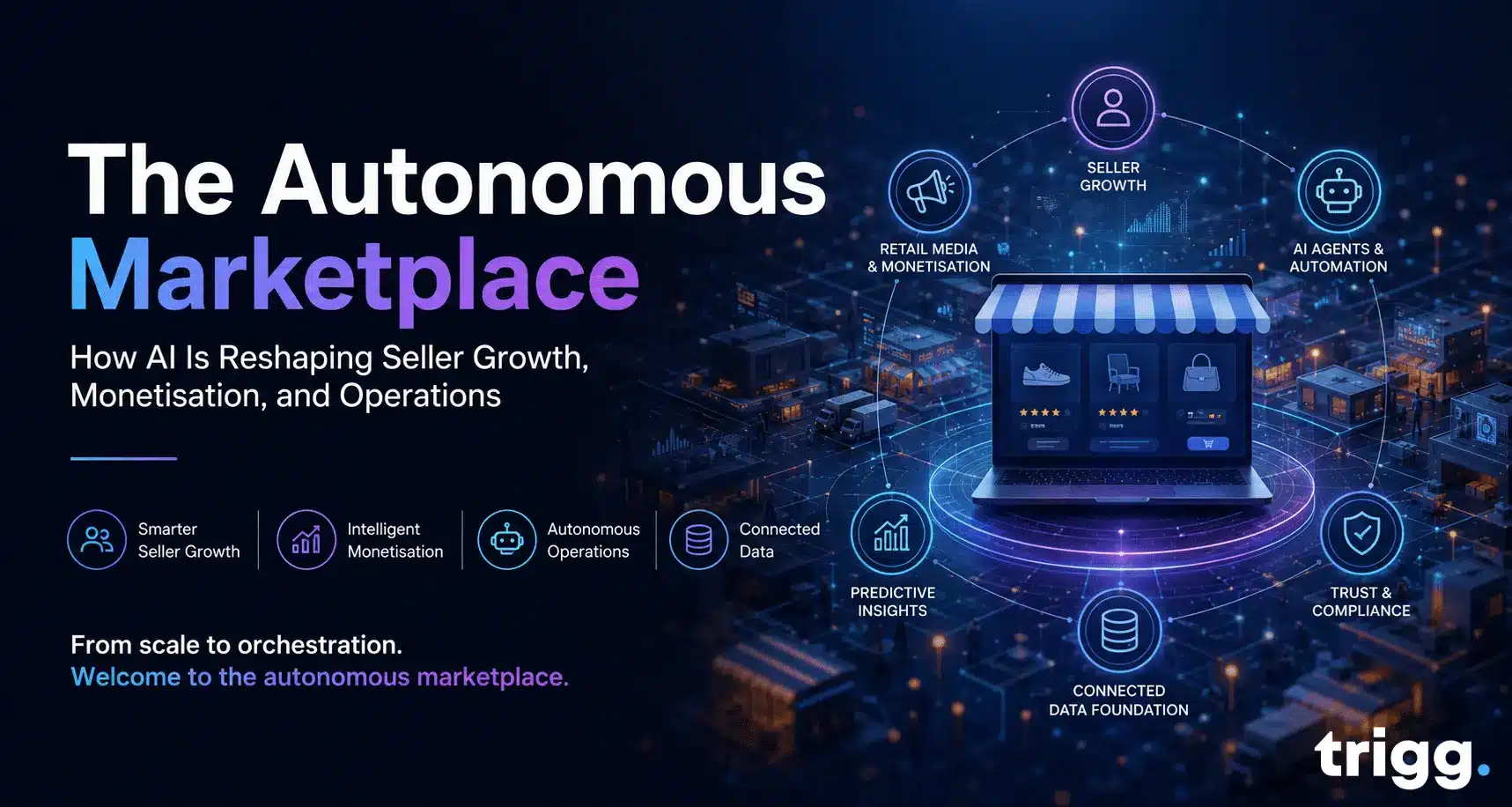
For the last decade, most marketplaces have focused on one thing: scale.
More sellers. More products. More categories. More transactions.
And for a while, scale was enough.
However, as marketplaces mature, leadership teams are discovering a new reality:
“Scale alone no longer creates enterprise value. The future belongs to the autonomous marketplace.
Across retail, classifieds, travel, hospitality, transport, financial services, and digital platform businesses, artificial intelligence is rapidly transforming marketplaces from manual operating models into intelligent, connected, and increasingly autonomous growth engines.
What was once a platform designed to connect supply and demand is now becoming something far more powerful:
An operating system for continuous growth.
If you missed our earlier perspectives on marketplace growth orchestration and seller lifecycle orchestration, this is the natural next evolution.
What Is an Autonomous Marketplace?
Most marketplaces were originally built to solve a relatively simple problem:
Connecting supply with demand.
However, few were designed to orchestrate thousands of sellers, millions of products, dynamic pricing, retail media inventory, compliance workflows, operational exceptions, and increasingly complex commercial models.
As marketplaces scale, operational complexity often grows faster than revenue.
Processes that once worked with 50 sellers begin to break at 500.
Seller recruitment sits in spreadsheets. Onboarding depends on email chains. Account managers spend their time reacting rather than driving growth. Support teams repeatedly solve the same operational issues. Media inventory is often sold manually.
In practice, every marketplace eventually reaches the same inflection point:
Manual growth becomes operational drag.
This is where the autonomous marketplace begins to emerge.
Not as a standalone AI tool.
But as an intelligent operating layer that continuously learns, adapts, and optimises.
AI Across the Autonomous Marketplace Seller Lifecycle
Seller growth has traditionally been highly manual.
Commercial teams identify potential merchants through market research, spreadsheets, referrals, inbound applications, and experience.
It works—until scale demands precision.
Today, AI is transforming every stage of seller lifecycle orchestration.
During acquisition, marketplaces can proactively identify which sellers to recruit next based on category gaps, supply imbalances, demand signals, competitive intelligence, and projected lifetime value.
During onboarding, AI can classify documents, route compliance workflows, enrich product data, identify catalogue gaps, and surface only the exceptions that require human judgment.
After go-live, AI can continuously guide sellers with personalised next-best actions—whether that means improving content, optimising pricing, increasing inventory, launching campaigns, or joining promotional opportunities.
As a result, leading marketplaces are no longer asking:
“Who wants to join our platform?”
Instead, they are asking:
“Which sellers should we recruit next—and how do we help them succeed faster?”
That is a fundamentally different operating model.
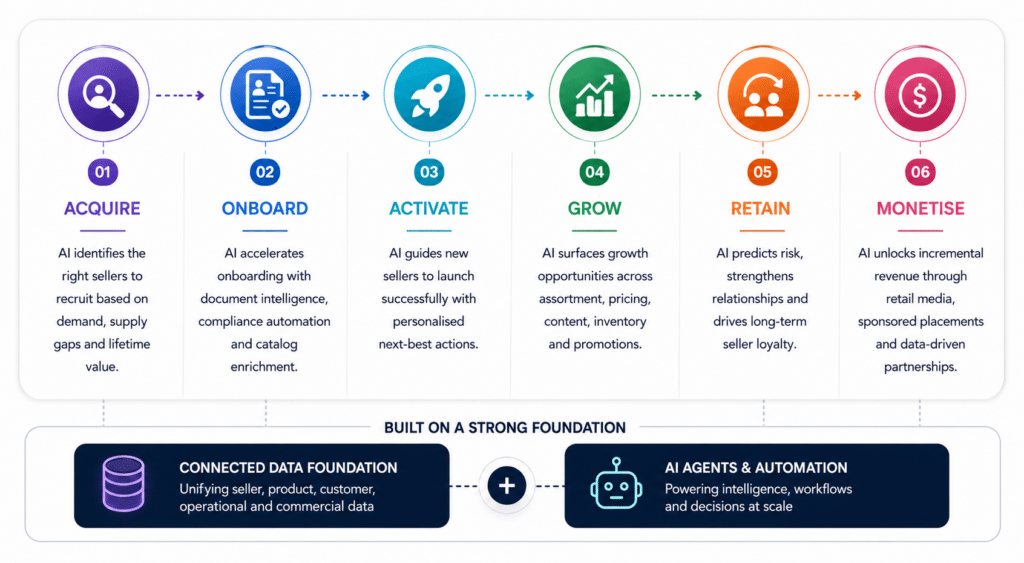
Figure 1. The Autonomous Marketplace Seller Lifecycle—AI, connected data, and automation powering seller acquisition, onboarding, activation, growth, retention, and monetisation.
How AI Improves Seller Growth and Retention
Most marketplace account management teams still operate reactively.
Revenue drops. Inventory declines. Ratings fall. Advertising spend slows. Support cases increase.
Only then does intervention begin.
By that stage, commercial value has often already leaked.
The autonomous marketplace changes this.
By analysing conversion trends, assortment depth, margin performance, advertising participation, service signals, and customer behaviour, AI can identify early indicators of churn or commercial underperformance—often weeks before they become visible to account teams.
As a result, marketplaces can intervene earlier, strengthen seller relationships, reduce churn, and drive higher GMV.
The best marketplaces are no longer managing sellers.
They are continuously orchestrating growth.
How AI Is Powering Marketplace Monetisation
For many marketplace leaders, the biggest future profit pools are no longer transactional.
They are media-driven.
Sponsored listings. Audience activation. Off-site campaigns. Data collaboration. Brand partnerships. Measurement. Attribution.
As a result, retail media monetisation is becoming one of the most attractive profit engines in modern commerce.
However, monetising inventory manually does not scale.
With connected first-party data and AI, marketplaces can now dynamically segment audiences, optimise sponsored placements, recommend campaign budgets, pace spend in real time, forecast demand, and unlock endemic, near-endemic, and non-endemic partnerships.
What was once a bolt-on revenue stream is rapidly becoming a core operating capability.
Increasingly, the line between marketplace operator and media owner is beginning to disappear.
AI Agents and Autonomous Marketplace Operations
As marketplaces grow, operational complexity expands across every function.
Seller support. Returns. Disputes. Compliance. Payment queries. Catalogue anomalies. Policy exceptions.
Meanwhile, operational teams are under constant pressure to do more with less.
This is where enterprise AI agents are beginning to play a critical role.
Across seller acquisition, onboarding, support, account management, retail media, and operational workflows, AI agents can now engage prospective sellers in real time, guide compliance processes, surface next-best actions, resolve exceptions, retrieve knowledge instantly, and support commercial decision-making at scale.
Platforms such as Salesforce, including capabilities like Agentforce and Data 360, are helping organisations operationalise AI safely, securely, and at enterprise scale. Learn more at Salesforce.
However, technology alone is not the differentiator.
The real advantage comes from combining connected data, trusted AI, operational design, and human oversight.
Why Connected Data Powers the Autonomous Marketplace
None of this works without connected data.
The autonomous marketplace depends on unifying seller data, customer data, product data, transaction data, advertising data, service data, and financial data into a single trusted foundation.
Without this, AI does not create intelligence.
It simply automates fragmentation.
However, with connected, governed, real-time data, AI becomes something far more powerful:
A growth multiplier.
The most successful autonomous marketplaces will not replace people with AI.
Instead, they will combine human judgment, predictive intelligence, autonomous workflows, and continuous monetisation to create platforms that recruit better sellers, onboard faster, retain longer, monetise deeper, operate leaner, and scale smarter.
That is the shift from marketplace platform…
To marketplace operating system.
That is the shift from digital marketplace…
To autonomous marketplace.
How Trigg Digital Helps Build the Autonomous Marketplace
At Trigg Digital, we help retailers, marketplaces, travel, hospitality, sports, financial services, and digital platforms design and scale the autonomous marketplace through connected data, seller lifecycle orchestration, retail media monetisation, and enterprise AI.
Together with platforms such as Salesforce and Mirakl, we help organisations go further, faster. Explore.
Because the future of marketplaces isn’t just digital.
It’s autonomous.
Is Your Marketplace Built for Scale… Or Autonomy?
Whether you’re launching a new marketplace, scaling seller growth, building a retail media business, or exploring enterprise AI agents, the operating model behind your platform matters.
