change management Archives - Trigg Digital

Posts tagged "change management"

ERP vs ARM: Who Should Control Revenue?

February 19th, 2026 Posted by AI, Insights, Revenue Management, Sales, Sales Automation 0 thoughts on “ERP vs ARM: Who Should Control Revenue?”

Every Enterprise Resource Planning (ERP) vs Agentforce Revenue Management (ARM) revenue control debate eventually lands in the same place:

“Shouldn’t ERP just handle this?”

It’s a logical instinct, because fewer systems feel safer and control feels clearer.

In practice, this assumption is one of the most common reasons revenue transformations stall.

The Problem Isn’t ERP — It’s Role Confusion

ERP systems are built to protect the business. They deliver accounting accuracy, compliance, and auditability. They create financial truth.

They are not designed to govern commercial decision-making.

When ERP is pushed into roles it was never built for — dynamic pricing, deal flexibility, customer-specific exceptions — organisations pay the price in slow change, brittle customisation, and frustrated commercial teams.

This isn’t a technology failure.
It’s an ownership failure.

We see this pattern repeatedly in large-scale commercial programmes, particularly where ownership of pricing and deal logic is unclear — a theme we explore further in Why Most CPQ Programmes Fail at Scale.

This is the core misunderstanding at the heart of the ERP vs ARM revenue control conversation.

Revenue Has Two Control Requirements

At its core, revenue operates across two distinct domains.

One is commercial: intent, negotiation, flexibility, speed.
The other is financial: recognition, compliance, certainty.

As a result, trying to force both into a single control point creates tension rather than clarity. Sales teams push for agility. Finance teams push for control. The system becomes the point of conflict.

What boards experience as “complexity” is often simply unclear ownership inside the architecture.

This is why revenue is no longer just a workflow — it is an operating model in its own right, as outlined in Revenue Is No Longer a Process — It’s an Operating System.

What High-Performing Revenue Models Do Differently

In practice, the most effective revenue organisations separate responsibility cleanly.

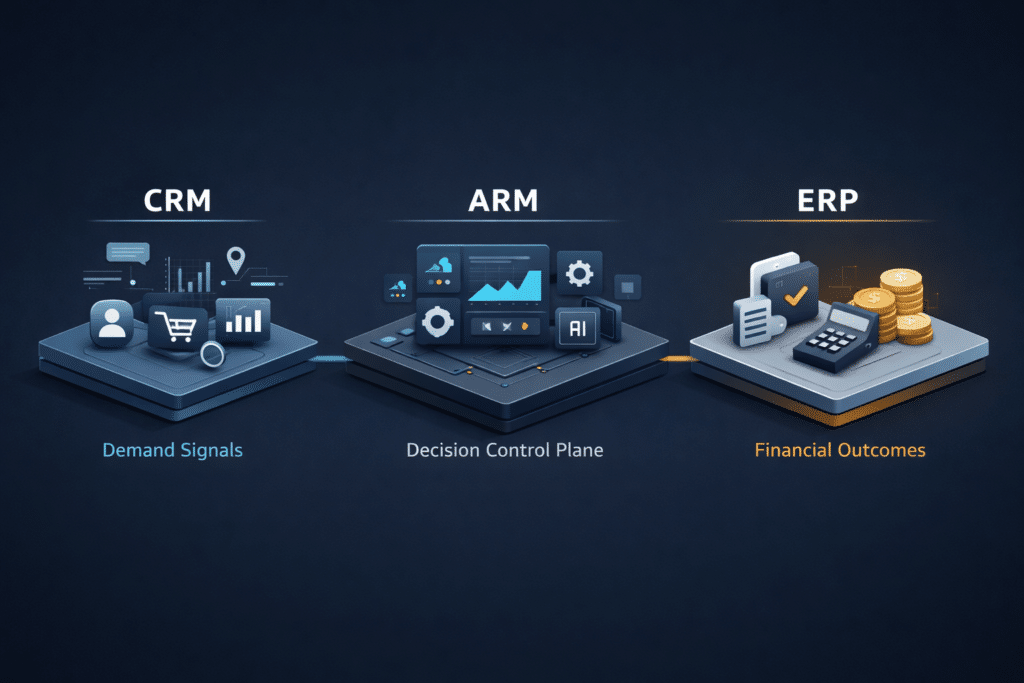
CRM captures demand and customer context.
ARM governs commercial intent, pricing logic, and policy.
ERP executes financial truth.

Each system does what it’s best at — no more, no less.

This separation reduces delivery risk, accelerates change, and builds trust between commercial and finance teams. It also avoids the downstream failures that often appear when billing and recognition are forced to absorb commercial complexity — a breakdown we unpack in Billing Is Where Revenue Transformations Go to Die.

In an ERP vs ARM revenue control model, this separation is what allows speed and governance to coexist.

Why This Matters Even More With AI and Agents

As organisations introduce AI and agent-led workflows, ambiguity becomes a liability.

By design, agents move fast. If logic is duplicated or ownership is unclear, errors scale quickly and accountability becomes harder to trace.

In this world, ARM acts as the control plane — ensuring decisions remain within defined commercial guardrails before execution in ERP.

ERP remains the system of record, while ARM becomes the system of decision.

That distinction is what enables speed without sacrificing control.

There Is No Universal Architecture

Some organisations extend their existing stack. Others replace specific components. Many land somewhere in between.

The right answer depends on how your business sells, how much flexibility you need, and where governance must sit.

At Trigg, we help leadership teams design revenue operating systems that reflect reality — complementing existing technology where it works, and replacing it where it doesn’t.

The goal is not consolidation for its own sake. Instead, it is clarity.

Executive Takeaway

Ultimately, ERP is essential to revenue transformation.
However, it is not the control plane.

Treating it as such slows innovation and increases risk — the opposite of what leaders intend.

The goal is not fewer systems. Rather, it is clear responsibility, governed autonomy, and a revenue operating model built for scale.

Designing Your Revenue Control Plane

Every organisation starts from a different place.

Some need clearer ownership across CRM, ARM, and ERP.
Others need to modernise legacy commercial layers.
Many need an operating model that is ready for AI-driven execution.

At Trigg, we help organisations define and implement revenue operating systems that scale — with governance designed in from day one.

If you’re reassessing revenue architecture, start with clarity — not consolidation.

Request a Revenue Operating System Assessment today.

Header illustration showing a stylised enterprise transformation with glowing systems and divergent human behaviour pathways.

Why Change Management Is the Hardest Part of Transformation

February 13th, 2026 Posted by AI, Insights, Revenue Management, Sales, Sales Automation 0 thoughts on “Why Change Management Is the Hardest Part of Transformation”

Most revenue transformations don’t fail in technology.
They fail in behaviour.

New platforms go live. Automation works. Dashboards light up. Yet months later, the same patterns reappear: sales teams bypass the system, deal desks quietly return, finance runs shadow controls, and AI agents are switched off or ignored.

This isn’t resistance.
It’s what happens when organisations fail to design change properly.

At Trigg, we see revenue transformation fail not because the platform is wrong — but because decision ownership, autonomy, and governance are never designed together.

Software executes decisions. Behaviour determines whether those decisions stick.

Transformation Fails in Behaviour, Not Software

Modern transformation programmes are very good at shipping systems.

They are far less effective at reshaping behaviour.

Dashboards lighting up does not mean teams have changed how they make decisions.
Automation running does not mean teams trust the system.
AI can make recommendations, but people won’t follow them without trust.

What breaks isn’t the tooling — it’s the gap between how decisions are supposed to be made and how people actually make them under pressure.

That gap is a change-management problem.

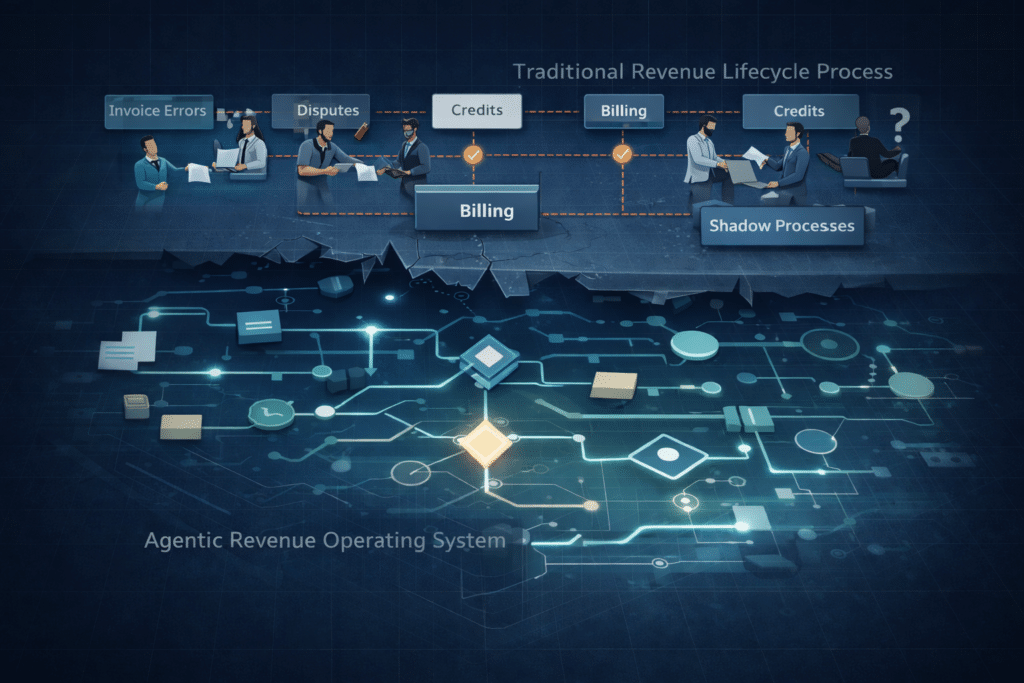
Minimalist isometric illustration of an enterprise revenue system: clean, glowing dashboards and automated workflows flow through a structured system, while muted, branching paths show manual overrides and shadow processes diverging from the core, with billing and revenue still converging intact in a modern, abstract corporate style.

Revenue Transformation Changes Decision-Making

Agentic revenue models don’t just improve efficiency. They change who decides.

Who can approve pricing.
When exceptions are allowed.
How renewals are triggered.
Which actions happen without human involvement.

That’s not just a system change — it reshapes the organisation.

When leaders don’t make decision boundaries explicit, teams default to familiar behaviours. Not out of defiance, but because ambiguity feels risky in revenue-critical moments.

Why Traditional Change Management Breaks Down

Most change programmes assume roles stay broadly the same, systems support people, and governance remains static.

Agentic revenue breaks all three assumptions.

Agents recommend, initiate, and enforce actions automatically. Without deliberate design, teams experience this shift as a loss of control rather than progress. People push back quietly by creating workarounds instead of confronting the change.

This is why revenue transformations most often collapse at the point of billing and execution — not strategy.

Isometric illustration comparing a traditional revenue lifecycle with an agentic revenue operating system, showing manual handoffs, people, approvals, and shadow processes above, and an automated, connected decision network operating beneath.

The Signals Change Was Never Designed

When organisations fail to manage change at the decision level, the same symptoms appear.

Sales teams create “one-off” exceptions that quickly become the norm.
Deal desks grow instead of shrinking.
A single unexplained AI decision undermines trust in the entire model.

Technology isn’t the problem. They signal that the organisation never adapted to the new way teams make decisions.

What Effective Change Looks Like in Practice

Successful organisations treat change management as a design discipline, not a communications exercise.

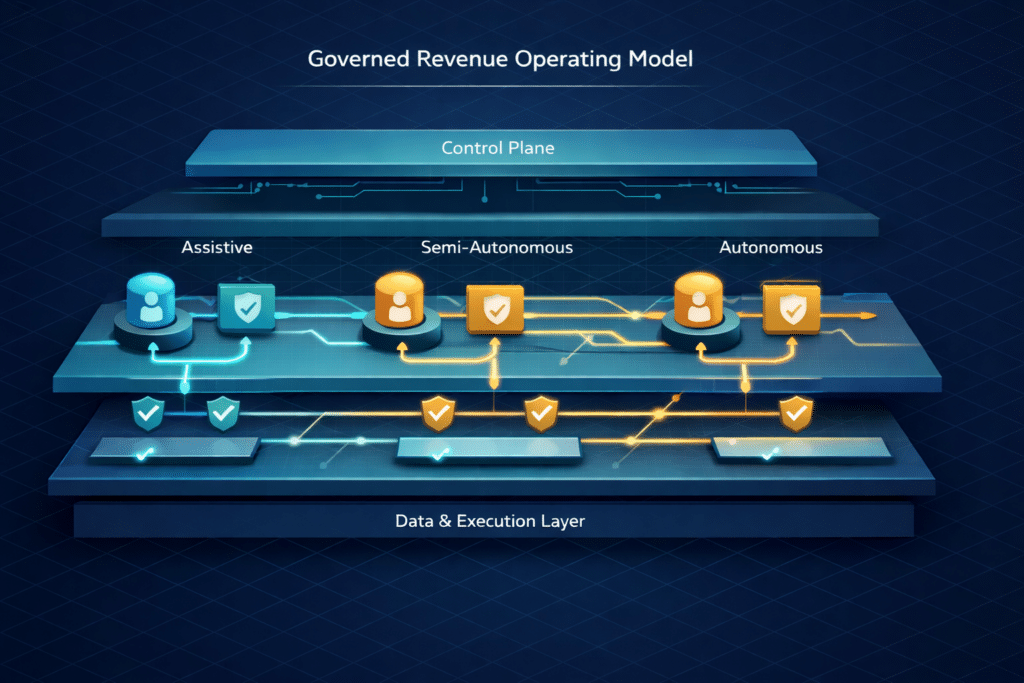
They make decision rights between humans and agents explicit. They introduce autonomy gradually, earning trust over time rather than demanding it at go-live.

And they focus on adoption as behaviour change, not feature usage.

Isometric diagram of a governed revenue operating model showing a layered control plane above assistive, semi-autonomous, and autonomous decision flows, with structured pathways, validation checkpoints, and balanced left-to-right progression on a dark blue grid.

The Leadership Imperative

Leaders cannot delegate change management.

When leaders remain ambiguous about agent-based revenue models, teams read that ambiguity as permission to revert. Visible executive sponsorship — of decision boundaries, accountability, and new ways of working — is what makes agentic revenue stick.

Executive Takeaway

Revenue transformation fails when organisations automate execution without first designing how decisions are made. Effective transformation requires leaders to:

  • Make decision rights explicit across humans and agents
  • Introduce autonomy progressively, with trust earned over time
  • Embed governance upstream in the operating model, not after execution

When behaviour, governance, and systems are designed together, transformation becomes durable.

When they are not, teams revert to workarounds — regardless of how advanced the technology is.

This is the design principle behind how Trigg helps organisations build governed, agent-ready revenue operating models — where change is engineered into the system, not left to chance.

Best Practices For Your CRM Centre of Excellence

July 28th, 2022 Posted by Adoption, Marketing Automation, Sales, Services 0 thoughts on “Best Practices For Your CRM Centre of Excellence”

Check out this week’s blog for 3 steps to building a CRM centre of excellence…

Building A CRM Centre Of Excellence: 3 Steps

July 19th, 2022 Posted by Adoption, Marketing Automation, Sales, Services 0 thoughts on “Building A CRM Centre Of Excellence: 3 Steps”

Check out this week’s blog for 3 steps to building a CRM centre of excellence…

The Importance Of Process – 4 Reasons Salesforce Implementations Fail

May 26th, 2022 Posted by Adoption, Automation, Data, Implementation, Technology 0 thoughts on “The Importance Of Process – 4 Reasons Salesforce Implementations Fail”

In today’s blog, we’re looking at how the process used can impact the success of a Salesforce project, focusing on the four most common ways that problems with your processes can cause the implementation to fail.

a hand holding the globe

Take It Global: Developing A Successful Multi-Market CRM Strategy

March 10th, 2022 Posted by Adoption, Culture, Implementation, Managed Services, Technology, Training & Certification 0 thoughts on “Take It Global: Developing A Successful Multi-Market CRM Strategy”

Trigg Co-Founder Chee Wan explores some of the challenges faced by businesses expanding onto the global market, as well as some of the solutions that can ensure success through multi-market CRM.

A person pointing at a whiteboard

The Importance Of People: 4 Reasons Global Salesforce Implementations Fail

March 8th, 2022 Posted by Adoption, Culture, Technology, Training & Certification 0 thoughts on “The Importance Of People: 4 Reasons Global Salesforce Implementations Fail”

Junior Salesforce Consultant, Deepika Kalyani shares her insights into whether implementing an Agile methodology can help you deliver faster and more effectively

Transitioning from Salesforce Admin to Consultant

March 1st, 2022 Posted by Technology 0 thoughts on “Transitioning from Salesforce Admin to Consultant”

>Jack Cheng joined Trigg in 2022 as a Salesforce consultant. After experiencing the transition from an ‘admin’ role to that of a ‘consultant’, he is keen to share his experiences with those going through similar changes…